The F-47 and the Integrated Kill Web: How Palantir, Anduril, and BlackSky Are Building the Brain of the Air Force
The F-47 NGAD fighter isn't just a plane; it's a flying data center. It relies on a "Kill Web" where BlackSky is the eyes, Anduril is the nervous system, and Palantir is the brain. Here is how they integrate.
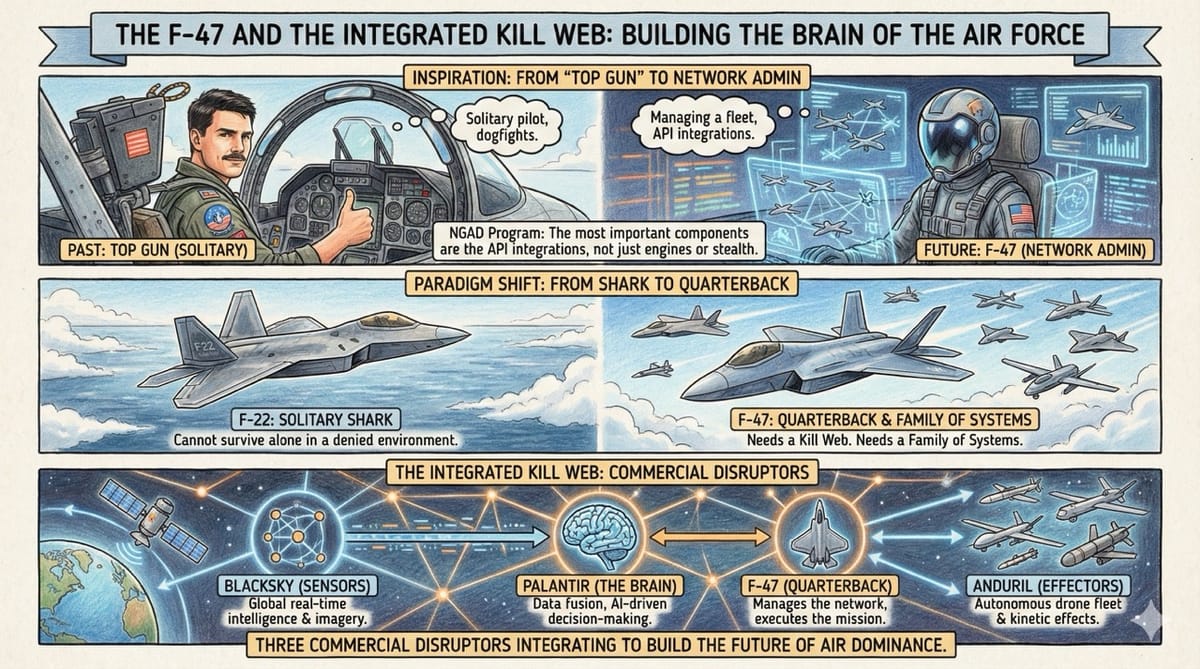
The days of the solitary "Top Gun" pilot are over. The F-47 pilot is a "Battle Network Administrator," managing a fleet of autonomous drones powered by a commercial software stack.
Inspiration: Reading the requirements for the Next Generation Air Dominance (NGAD) program and realizing that the most important components aren't the engines or the stealth coating, but the API integrations.
The emergence of the Boeing F-47 as the centerpiece of the NGAD program marks a definitive inflection point.
We are moving beyond the paradigm of the F-22 (a solitary shark) to the F-47 (a quarterback).
The core thesis is simple: The F-47 cannot survive alone in a "denied environment" (like the Taiwan Strait). It needs a "Family of Systems." It needs a Kill Web.
Here is how three commercial disruptors (BlackSky, Palantir, and Anduril) integrate to build that web.
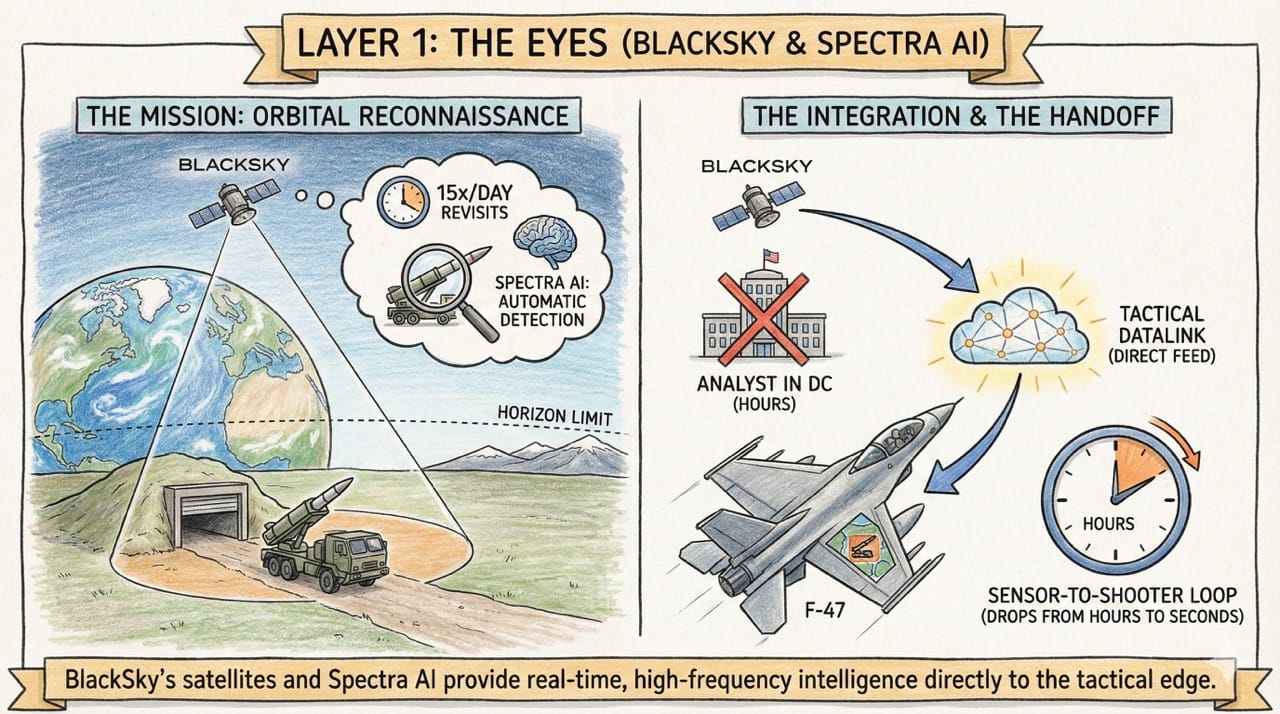
Layer 1: The Eyes (BlackSky & Spectra AI)
The F-47’s onboard sensors are limited by the horizon. It can't see what's 1,000 miles away. BlackSky can.
The Mission: Orbital Reconnaissance.
The Integration: BlackSky’s LEO satellites provide high-frequency revisits (15x/day). Their Spectra AI automatically detects enemy movements (e.g., a mobile missile launcher moving from a garage).
The Handoff: This data doesn't go to an analyst in DC. It is fed directly into the tactical datalink. The "Sensor-to-Shooter" loop drops from hours to seconds.
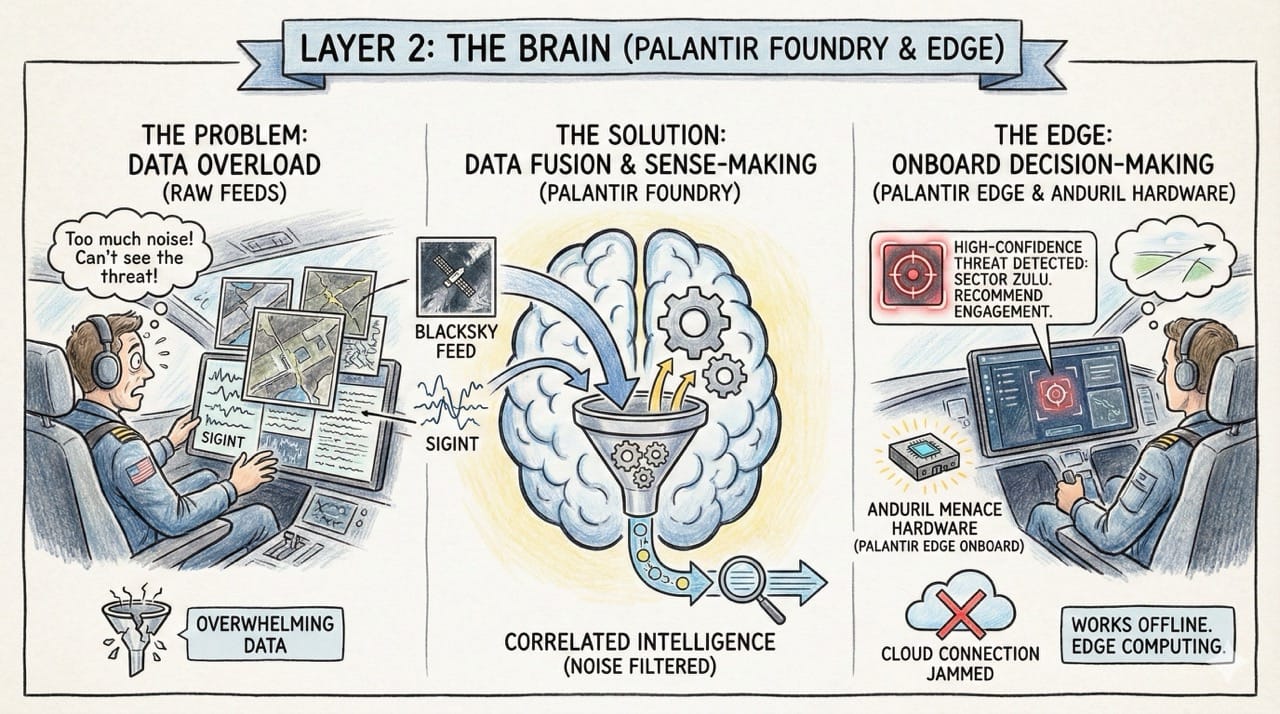
Layer 2: The Brain (Palantir Foundry & Edge)
Data is useless if it's overwhelming. A pilot in a supersonic cockpit can't look at raw satellite feeds.
Enter Palantir.
The Mission: Data Fusion & Sense-Making.
The Integration: Palantir Foundry ingests the BlackSky feed, correlates it with SIGINT (signals intelligence), and filters out the noise.
The Edge: Crucially, Palantir Edge runs onboard the aircraft (likely on Anduril's "Menace" hardware). It works even if the cloud connection is jammed. It tells the pilot: "High-confidence threat detected at Sector Zulu. Recommend engagement."
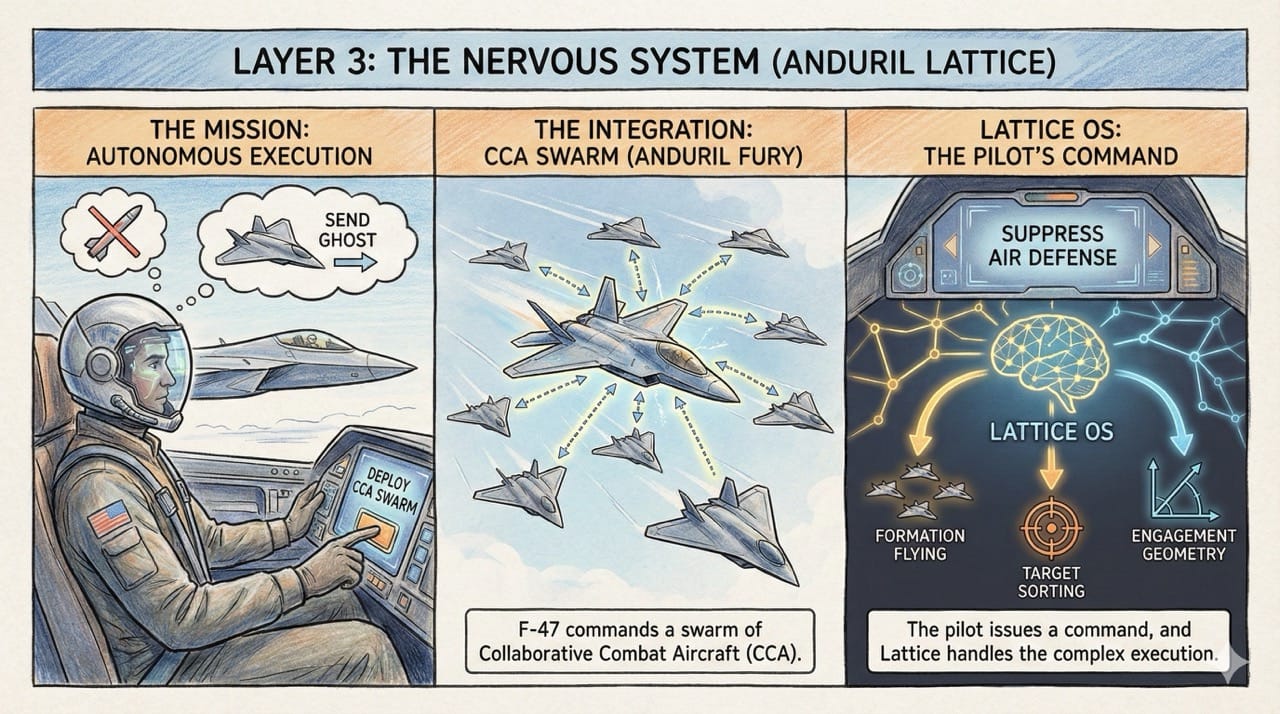
Layer 3: The Nervous System (Anduril Lattice)
The pilot decides to shoot. But they don't fire a missile themselves. They send a Ghost.
Enter Anduril.
The Mission: Autonomous Execution.
The Integration: The F-47 commands a swarm of Collaborative Combat Aircraft (CCA)—likely variants of the Anduril Fury.
Lattice OS: The pilot doesn't fly the drones. Lattice flies them. The pilot issues a command ("Suppress Air Defense"), and Lattice handles the formation flying, target sorting, and engagement geometry.
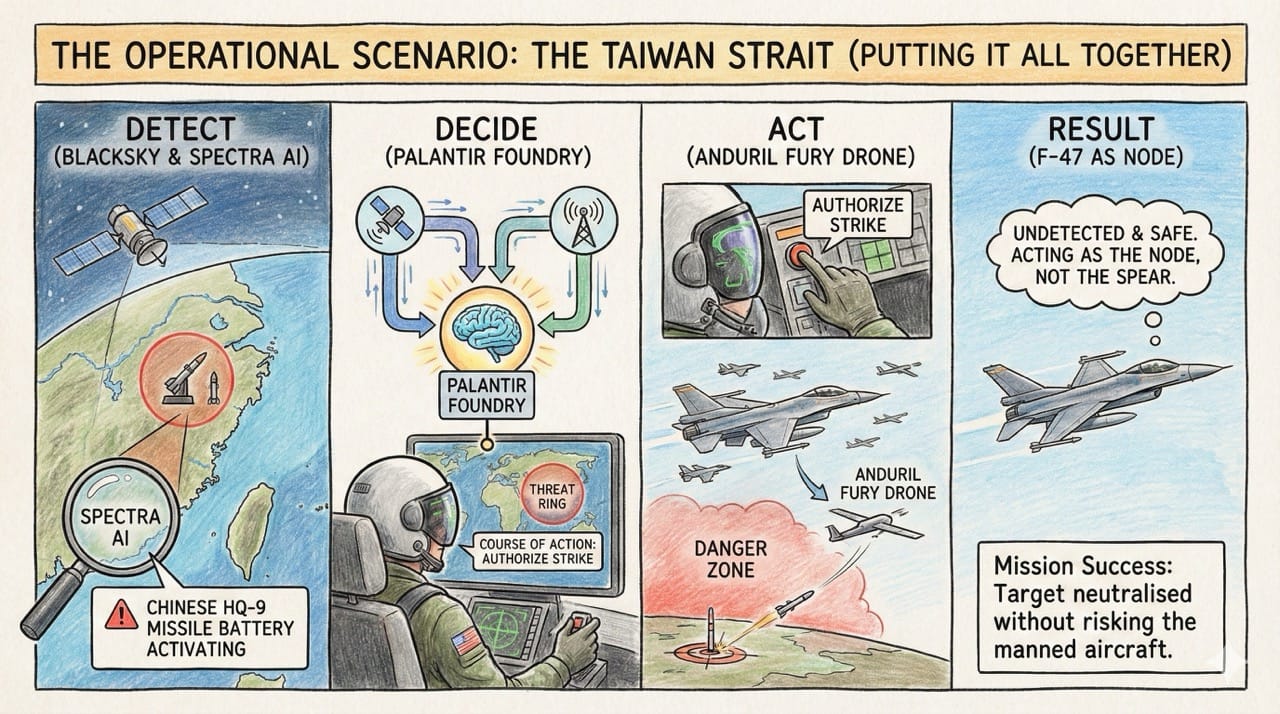
The Operational Scenario: The Taiwan Strait
Let’s put it all together in a conflict scenario.
Detect (BlackSky): A satellite spots a Chinese HQ-9 missile battery activating deep inland. Spectra AI flags it.
Decide (Palantir): Palantir Foundry fuses this with radio intercepts. It calculates the threat ring. It presents the F-47 pilot with a "Course of Action."
Act (Anduril): The pilot authorizes the strike. An Anduril Fury drone detaches from the formation, flies ahead into the danger zone, and launches a jamming decoy or kinetic strike.
Result: The F-47 remains undetected and safe, acting as the node, not the spear.
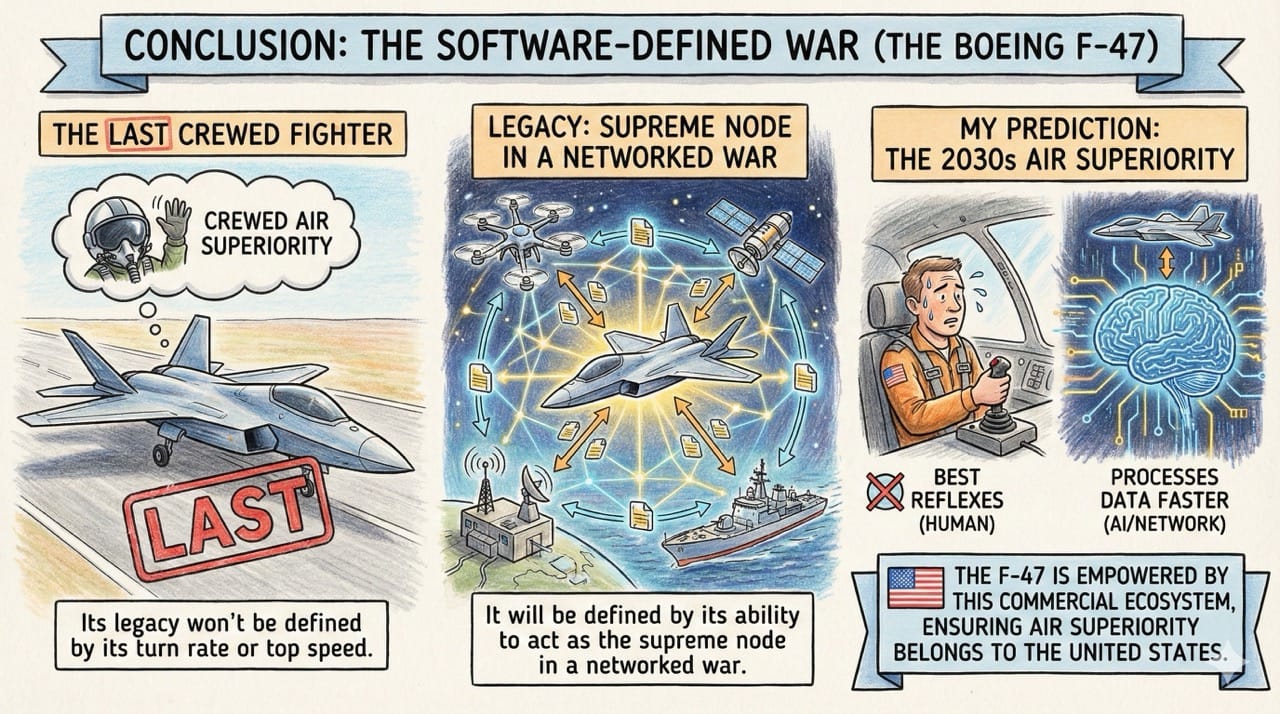
Conclusion: The Software-Defined War
The Boeing F-47 will likely be the last crewed air superiority fighter the US ever builds.
Its legacy won't be defined by its turn rate or top speed. It will be defined by its ability to act as the supreme node in a networked war.
My Prediction: In the 2030s, air superiority won't belong to the pilot with the best reflexes. It will belong to the side that processes data faster than the enemy can react. The F-47, empowered by this commercial ecosystem, is designed to ensure that side is the United States.