The End of Innovation: Why Every Product You Love Turns Into a Casino
Tech companies and game studios no longer want to build better products. They want to trap you in an ecosystem and charge you rent. The transition from innovation to extraction is the defining economic tragedy of our time.

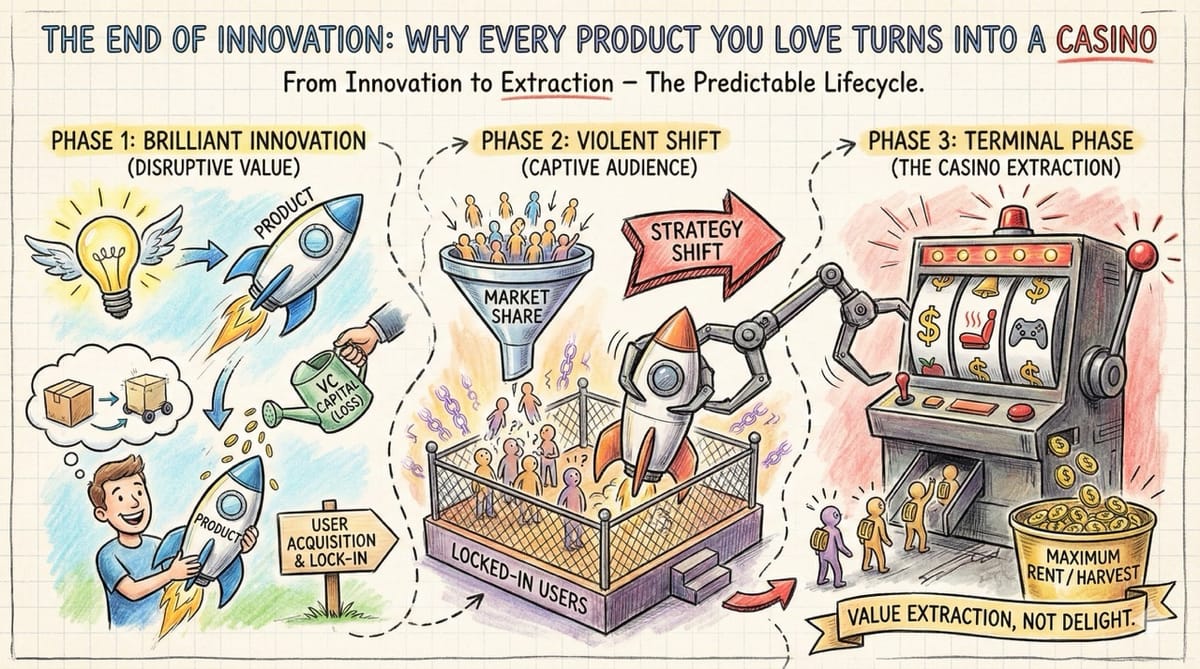
From video games to heated car seats, the global economy has stopped expanding the pie. Instead, it is focused entirely on harvesting captive audiences.
Inspiration: Listening to Palmer Luckey on the TBPN podcast discuss his desire to disrupt the video game industry. He correctly identified that legacy studios abandoned true innovation years ago in favor of pure financial extraction.
There is a predictable lifecycle for almost every modern corporate enterprise. It always begins with a brilliant phase of disruptive innovation.
The company creates a product that solves a real problem and delivers massive value to the consumer.
During this initial phase, the company often operates at a loss. They use venture capital to subsidize the product and acquire as many users as possible.
But once a critical mass of market share is achieved and the users are locked in, the strategy violently shifts.
The company stops trying to make the product better. Instead, it begins the terminal phase of value extraction.
The goal is no longer to delight the customer, but to harvest maximum rent from a captive audience.
The Video Game Archetype
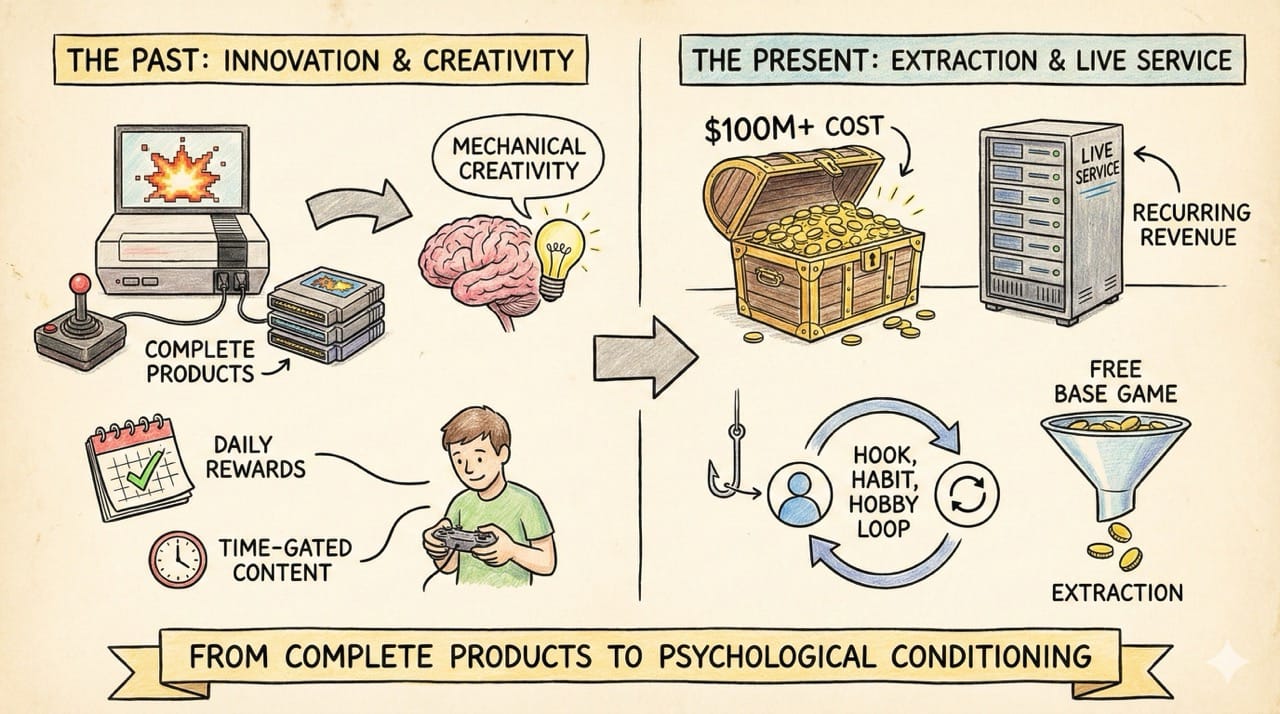
The video game industry is the most vivid example of this innovation-to-extraction pipeline. Two decades ago, explosive growth was driven by rapid hardware innovation and mechanical creativity.
Today, developing a major blockbuster title costs upwards of 100 million dollars.
Because the financial risk is so high, major publishers completely stopped innovating.
They pivoted away from selling self-contained, complete entertainment products.
The industry universally embraced the "live service" model to guarantee continuous recurring revenue.
They now rely on a psychological cycle known as the "Hook, Habit, Hobby" loop. They offer the base game for free to lower the barrier to entry.
Then they use daily login rewards and time-gated content to condition the user into a daily habit.
The Rise of Simulated Gambling
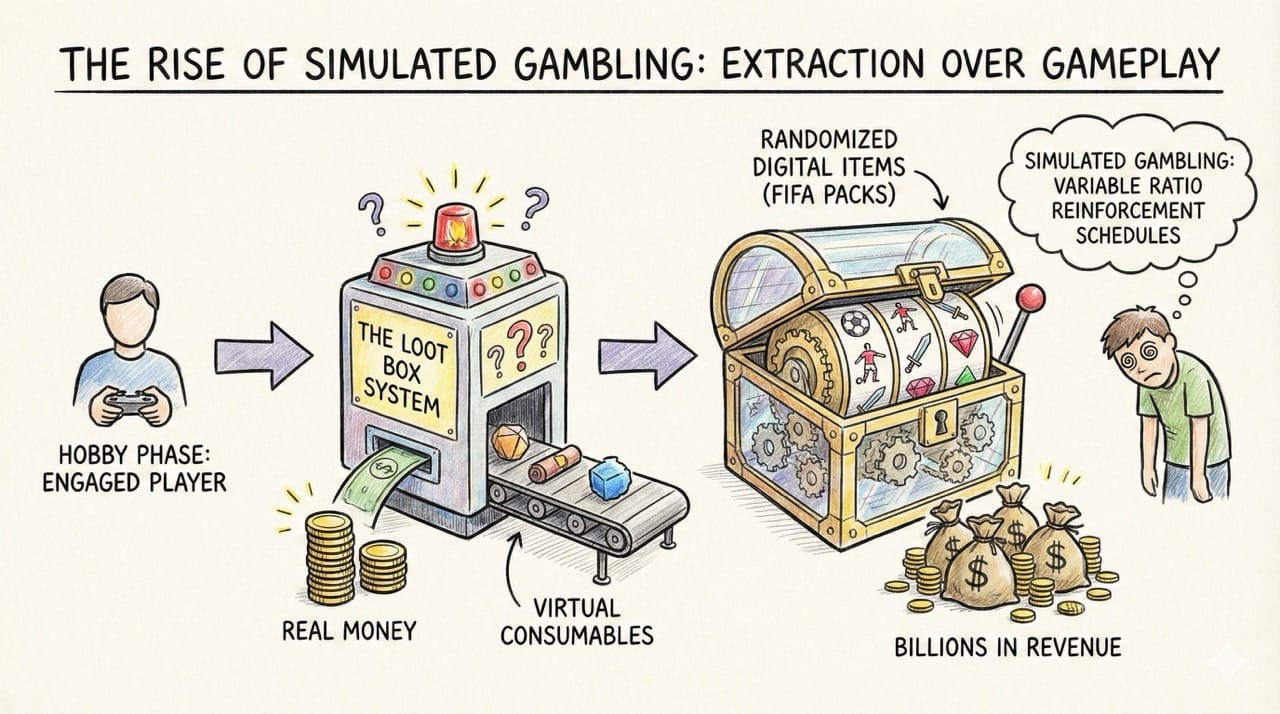
Once the user reaches the hobby phase, the aggressive extraction mechanisms are activated. The most lucrative tactic is the "loot box" system.
This is essentially a virtual consumable that yields a randomized selection of digital items.
Electronic Arts perfected this model with their FIFA franchise.
Users purchase digital points with real money to open randomized packs of soccer players. It generated billions of dollars in revenue without requiring the developers to actually improve the core gameplay.
This is not game design.
It is simulated gambling integrated directly into a home entertainment product.
It exploits variable ratio reinforcement schedules to deliberately foster addiction among players.
The Eradication of Ownership
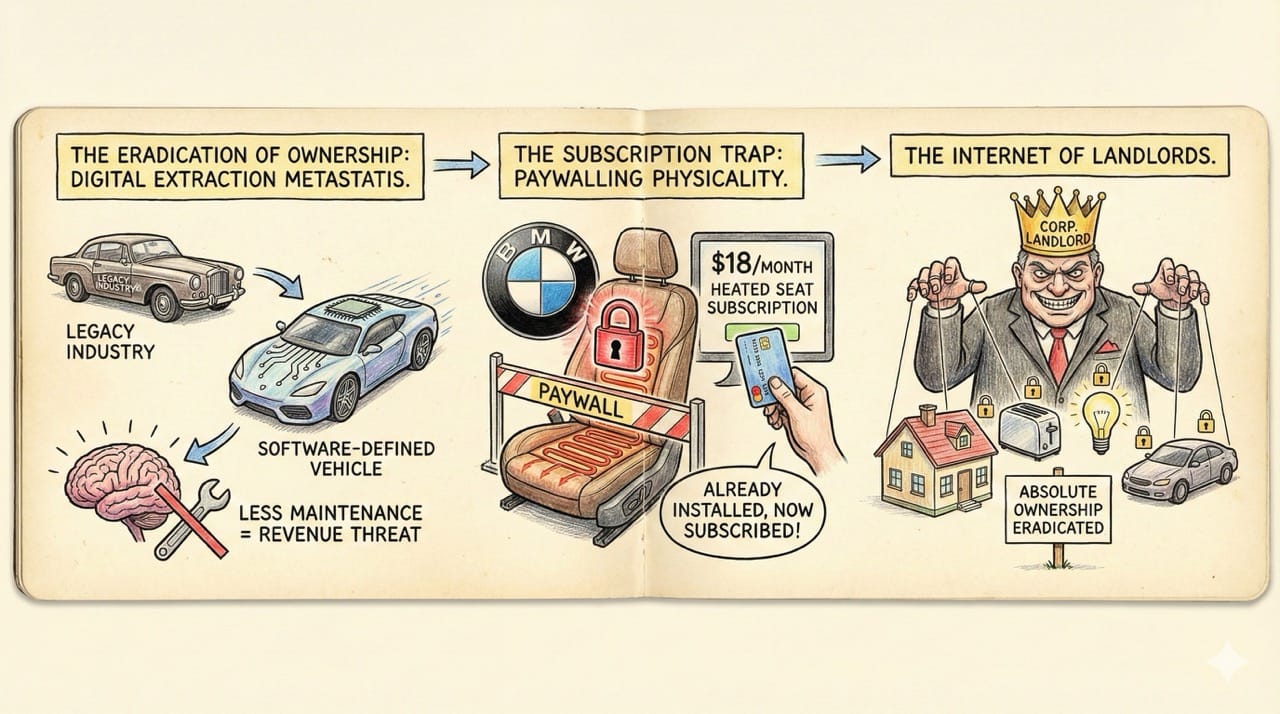
This logic of digital extraction has metastasized into physical products and legacy industries.
The automotive sector is currently undergoing a radical transition toward software-defined vehicles.
Automakers realize that electric vehicles require less mechanical maintenance, which threatens their long-term service revenue.
To compensate, they are converting physical vehicle features into monthly subscriptions.
BMW infamously tried to charge users a monthly fee to activate heated seats. The critical issue is that the physical heating coils were already installed in the car at the factory.
BMW was not providing a new service. They were using software to arbitrarily paywall existing physical capabilities that the consumer had already purchased.
This represents a fundamental shift toward an "Internet of Landlords" where absolute ownership is eradicated.
The Platform Decay Trap
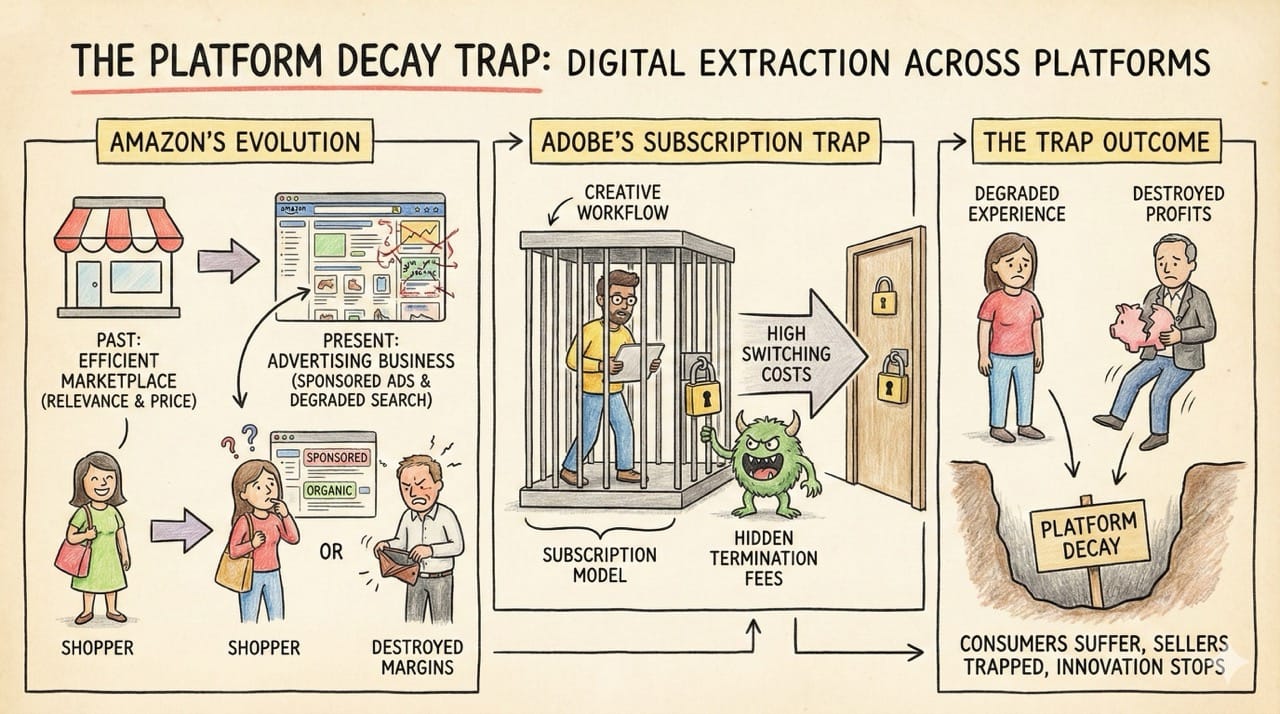
We see this exact same decay across all digital platforms. Amazon used to be an efficient marketplace that connected buyers and sellers based on relevance and price.
Today, it has systematically transitioned into a high-margin advertising business.
Sellers are effectively forced to purchase sponsored product placements just to maintain basic visibility.
Amazon utilizes complex rendering techniques to blend these paid ads with organic results. The consumer suffers a degraded search experience, and the seller suffers destroyed profit margins.
Similarly, software companies like Adobe trapped professional creatives in inescapable subscription models. They deployed deceptive design patterns and hidden termination fees to prevent users from leaving.
Because their software is entrenched in professional workflows, the switching costs are astronomically high.
Conclusion: The Builder's Rebellion
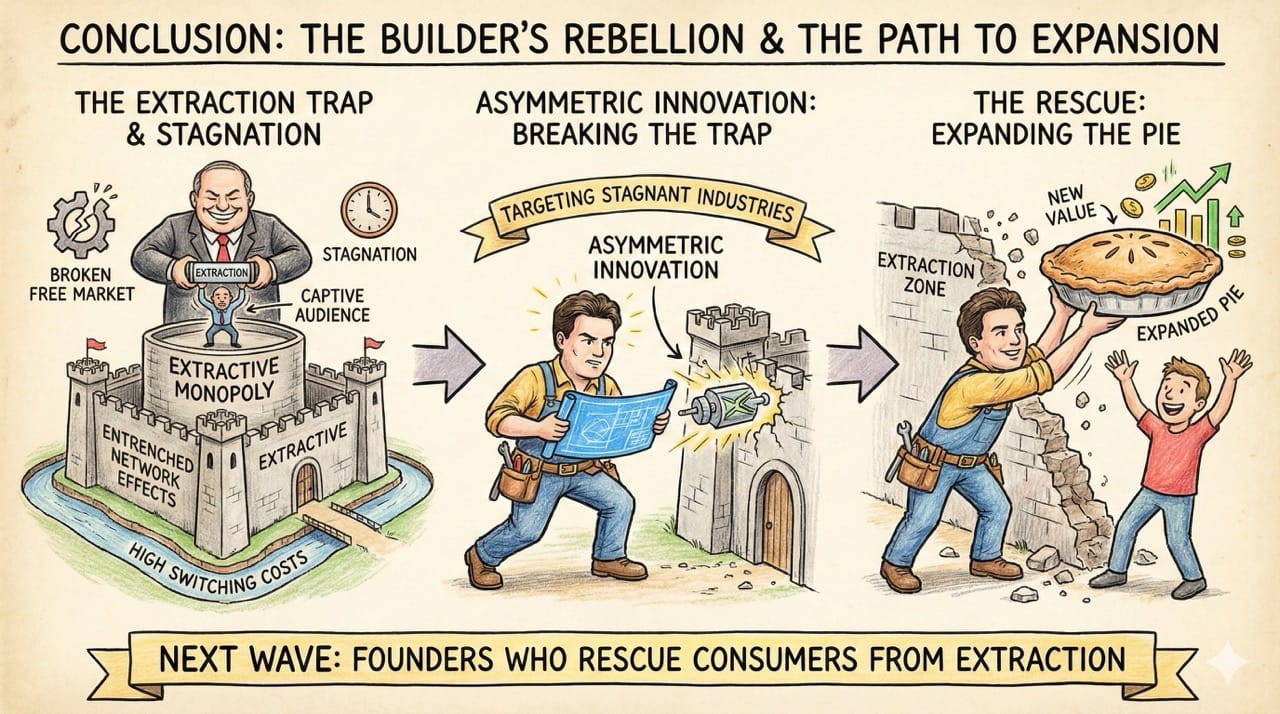
When switching costs are high and network effects are deeply entrenched, the free market stops working.
Companies are no longer disciplined by the threat of losing customers.
This leads to a systemic stagnation of technological progress.
You cannot regulate your way out of this trap. Bureaucratic rules often just create more friction for the end user.
The only way to break an extractive monopoly is through asymmetric innovation.
This is exactly why builders like Palmer Luckey are targeting these stagnant industries.
The market is desperate for companies that actually want to expand the pie rather than just squeezing the captive audience.
The next great wave of wealth will go to founders who rescue consumers from the extraction zone.