The Doorman Fallacy: Why Efficiency is the Enemy of Magic in the Age of AI
We are using AI to strip-mine "inefficiency" from the world. But as Rory Sutherland warns, we are often stripping out the value. The future belongs to "Artificial Alchemy," not just intelligence.

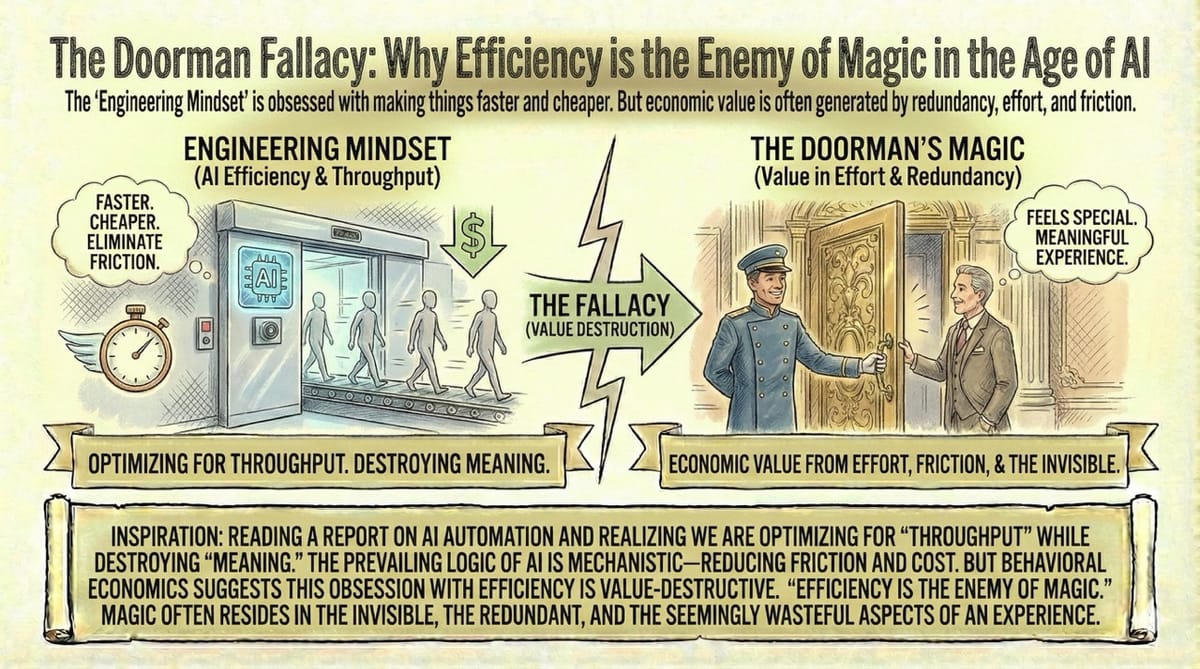
The "Engineering Mindset" is obsessed with making things faster and cheaper. But economic value is often generated by the very things engineers try to eliminate: redundancy, effort, and friction.
Inspiration: Reading a report on AI automation and realizing we are optimizing for "throughput" while destroying "meaning."
The prevailing logic of AI is mechanistic. It prioritizes the reduction of friction, the elimination of cost, and the acceleration of throughput.
But a rigorous analysis of behavioral economics (anchored by Rory Sutherland) suggests this obsession with efficiency is potentially value-destructive.
"Efficiency is the enemy of magic."
Magic often resides in the invisible, the redundant, and the seemingly wasteful aspects of an experience.
The Doorman Fallacy
To understand this, look at the "Doorman Fallacy."
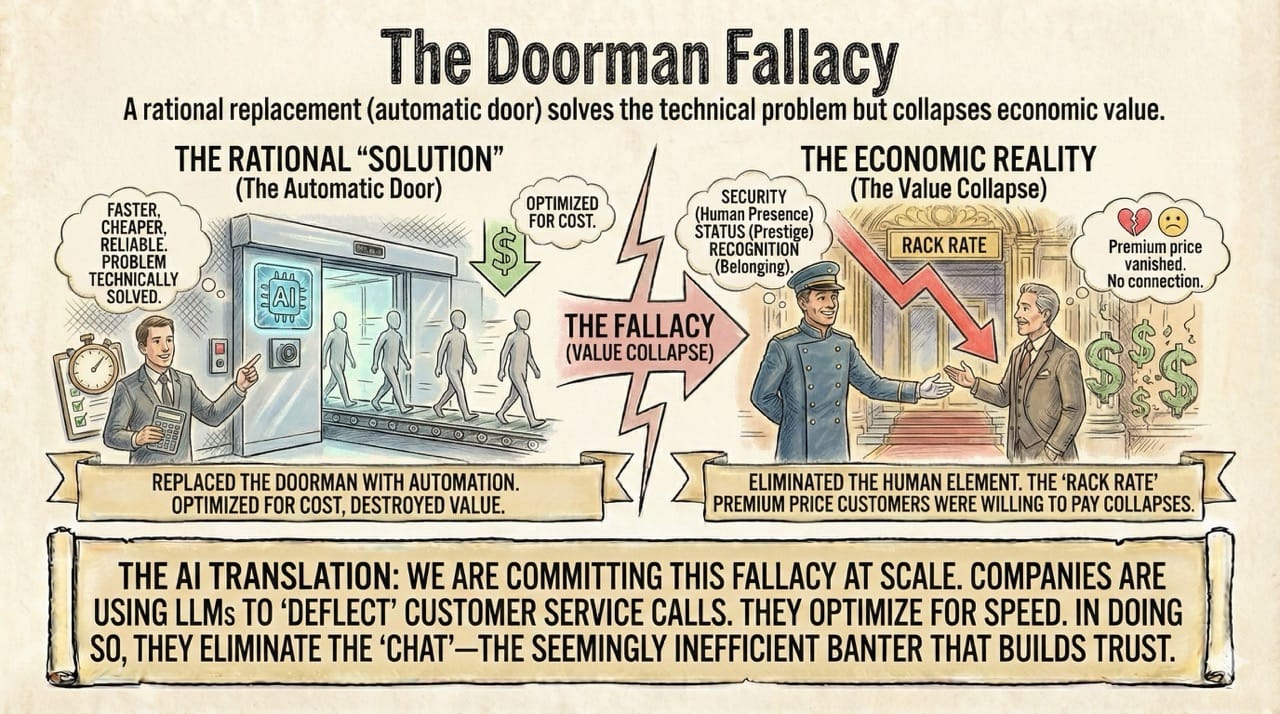
A management consultant analyzes a hotel doorman. From a rational perspective, his role is "opening the door." The consultant replaces him with an automatic sliding door. It is faster, cheaper, and more reliable.
Technically, the problem is solved. Economically, the value collapses.
The doorman wasn't just opening a door. He provided:
- Security: A human presence signals safety.
- Status: A uniformed attendant signals prestige.
- Recognition: Being greeted by name creates belonging.
By optimizing for the cost of door-opening, the hotel destroys the "rack rate"—the premium price customers were willing to pay.
The AI Translation: We are committing this fallacy at scale. Companies are using LLMs to "deflect" customer service calls. They optimize for speed. In doing so, they eliminate the "chat"—the seemingly inefficient banter that builds trust.
The Eurostar Paradox (Chronos vs. Kairos)
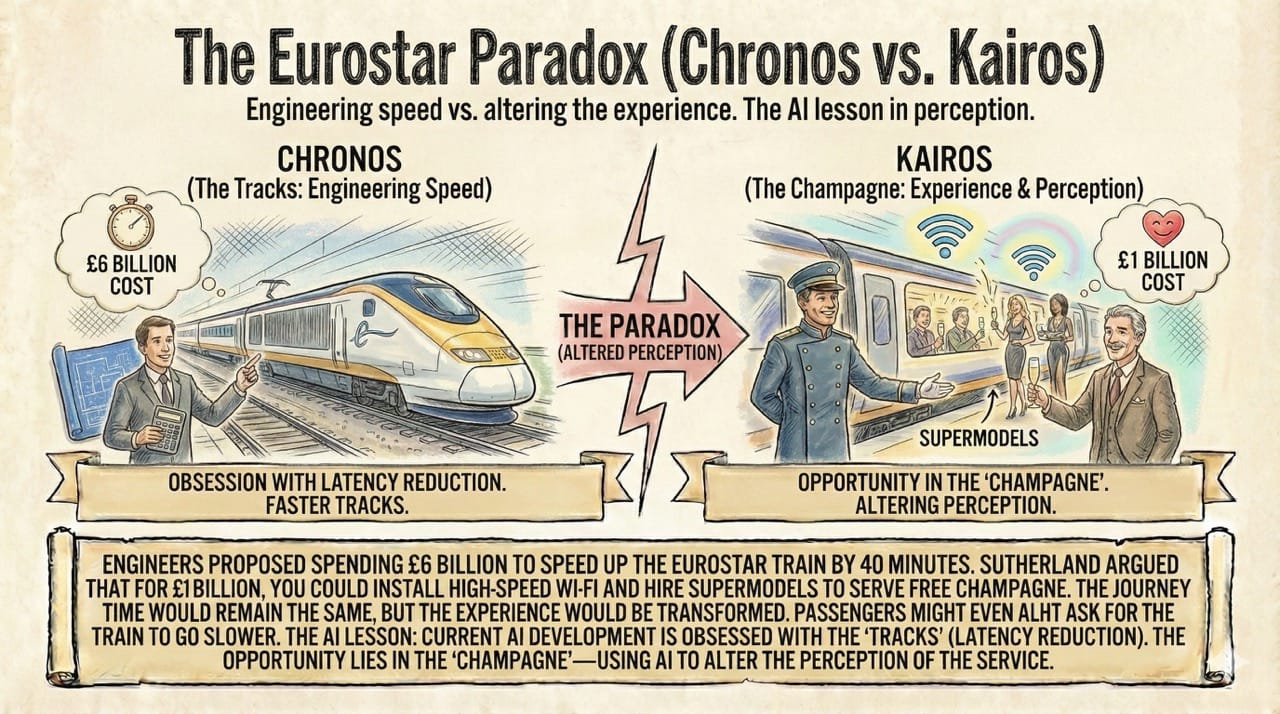
Engineers proposed spending £6 billion to speed up the Eurostar train by 40 minutes.
Sutherland argued that for £1 billion, you could install high-speed Wi-Fi and hire supermodels to serve free champagne.
The journey time would remain the same, but the experience would be transformed. Passengers might even ask for the train to go slower.
The AI Lesson: Current AI development is obsessed with the "tracks" (latency reduction). The opportunity lies in the "champagne"—using AI to alter the perception of the service.
The "Digital IKEA Effect"
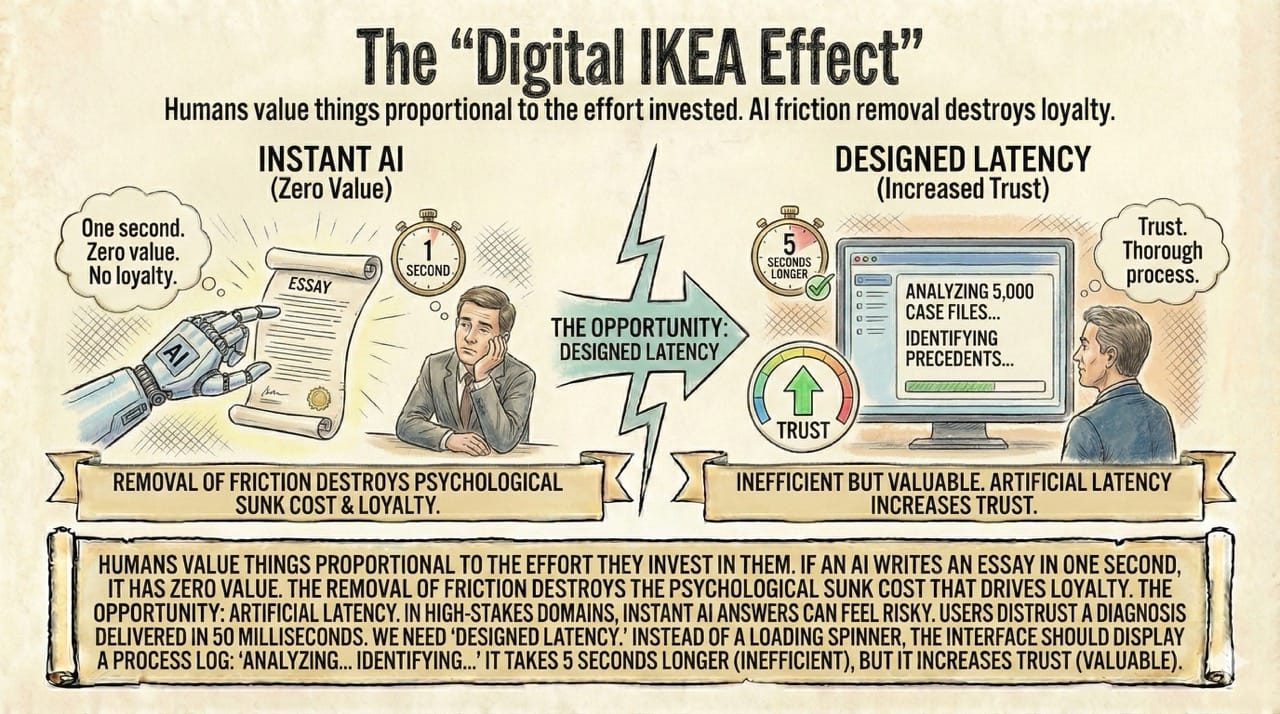
Humans value things proportional to the effort they invest in them.
If an AI writes an essay in one second, it has zero value. The removal of friction destroys the psychological sunk cost that drives loyalty.
The Opportunity: Artificial Latency In high-stakes domains (legal, medical), instant AI answers can feel risky. Users distrust a diagnosis delivered in 50 milliseconds.
We need "Designed Latency." Instead of a loading spinner, the interface should display a process log: "Analyzing 5,000 case files... Identifying precedents..."
It takes 5 seconds longer (inefficient), but it increases trust (valuable).
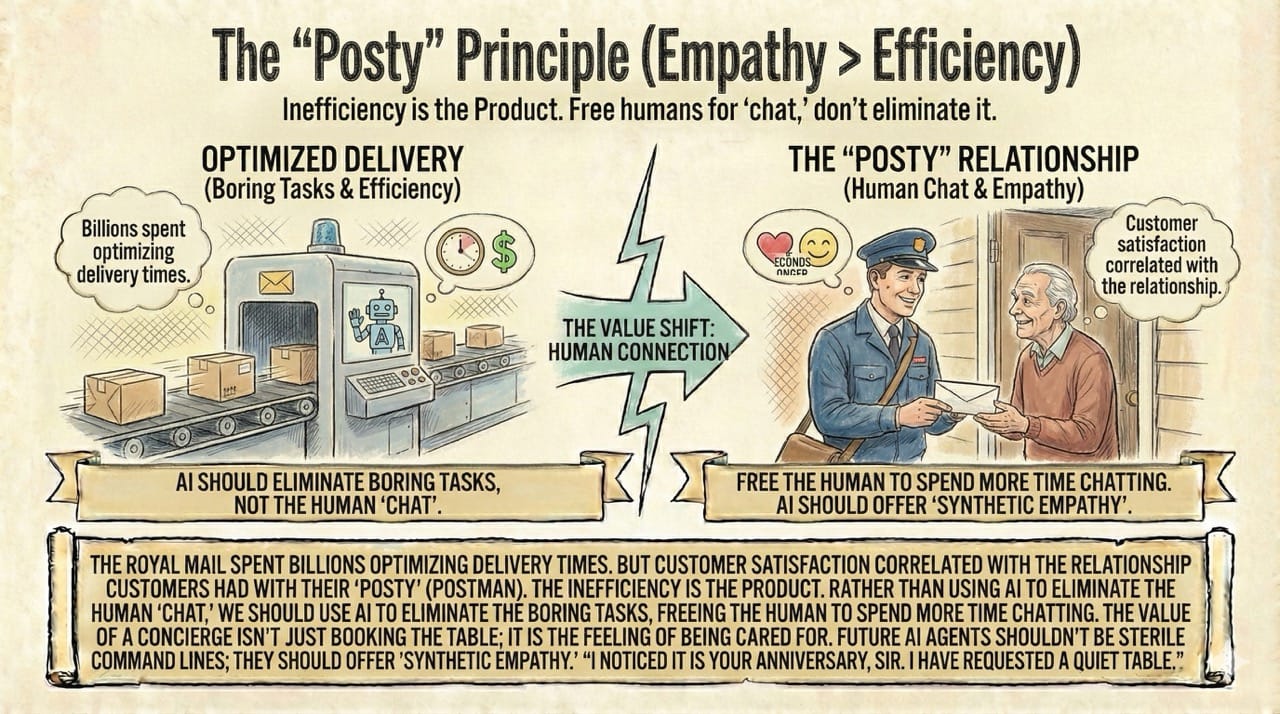
The "Posty" Principle (Empathy > Efficiency)
The Royal Mail spent billions optimizing delivery times. But customer satisfaction correlated with the relationship customers had with their "posty" (postman).
The Inefficiency is the Product.
Rather than using AI to eliminate the human "chat," we should use AI to eliminate the boring tasks, freeing the human to spend more time chatting.
The value of a Concierge isn't just booking the table; it is the feeling of being cared for. Future AI agents shouldn't be sterile command lines; they should offer "Synthetic Empathy."
"I noticed it is your anniversary, sir. I have requested a quiet table."
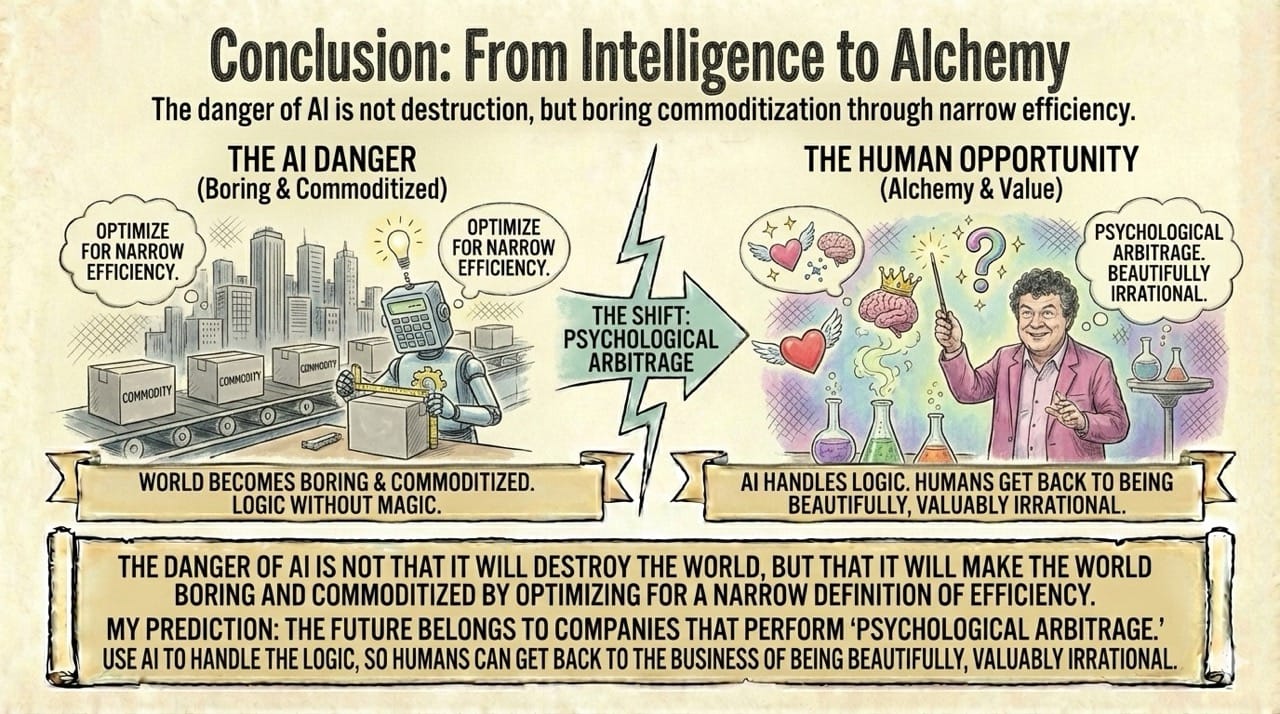
Conclusion: From Intelligence to Alchemy
The danger of AI is not that it will destroy the world, but that it will make the world boring and commoditized by optimizing for a narrow definition of efficiency.
My Prediction: The future belongs to companies that perform "Psychological Arbitrage."
They will use AI to handle the logic, so humans can get back to the business of being beautifully, valuably irrational.