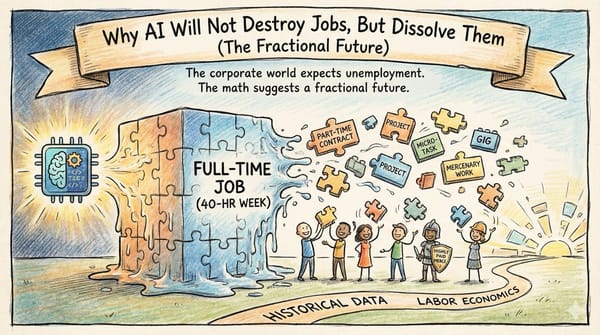
The Corporate Gold Standard: Why Every Tech Giant Will Mint Its Own Money
The era of paying massive interchange fees to credit card monopolies is officially ending. Tech giants are realizing they can bypass the traditional banking system entirely. Within a few years, your favorite software company will also be your primary bank.

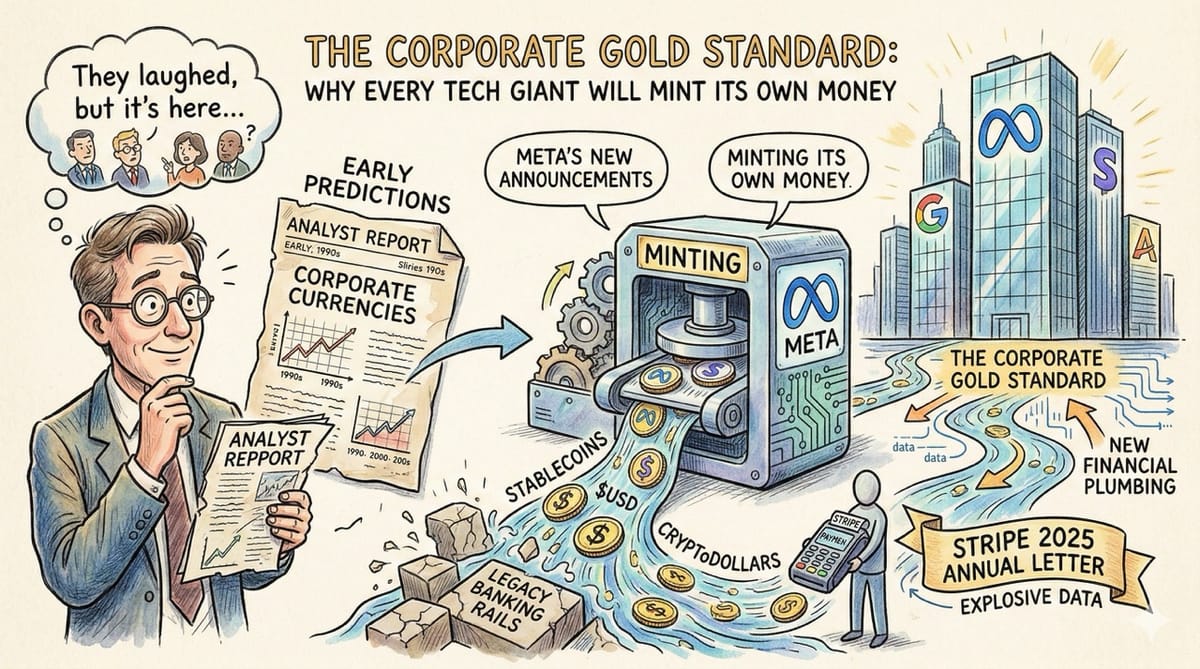
From the ashes of Meta's failed Libra project to the explosive data in Stripe's 2025 Annual Letter, the corporate stablecoin revolution has quietly arrived.
Inspiration: Reading an old analyst report predicting the rise of corporate currencies, and suddenly seeing it validate in real time with Meta's new announcements and Stripe's latest payment data.
A few years ago, a prominent analyst predicted that every major tech company would eventually issue its own currency.
Most of the financial world laughed at the idea. Today, with Meta's recent strategic moves and the hard data presented in Stripe's 2025 Annual Letter, that prediction is an undeniable reality.
The tech industry is no longer just building software and hardware.
They are actively building new financial plumbing.
They are replacing legacy banking rails with cryptographic dollars.
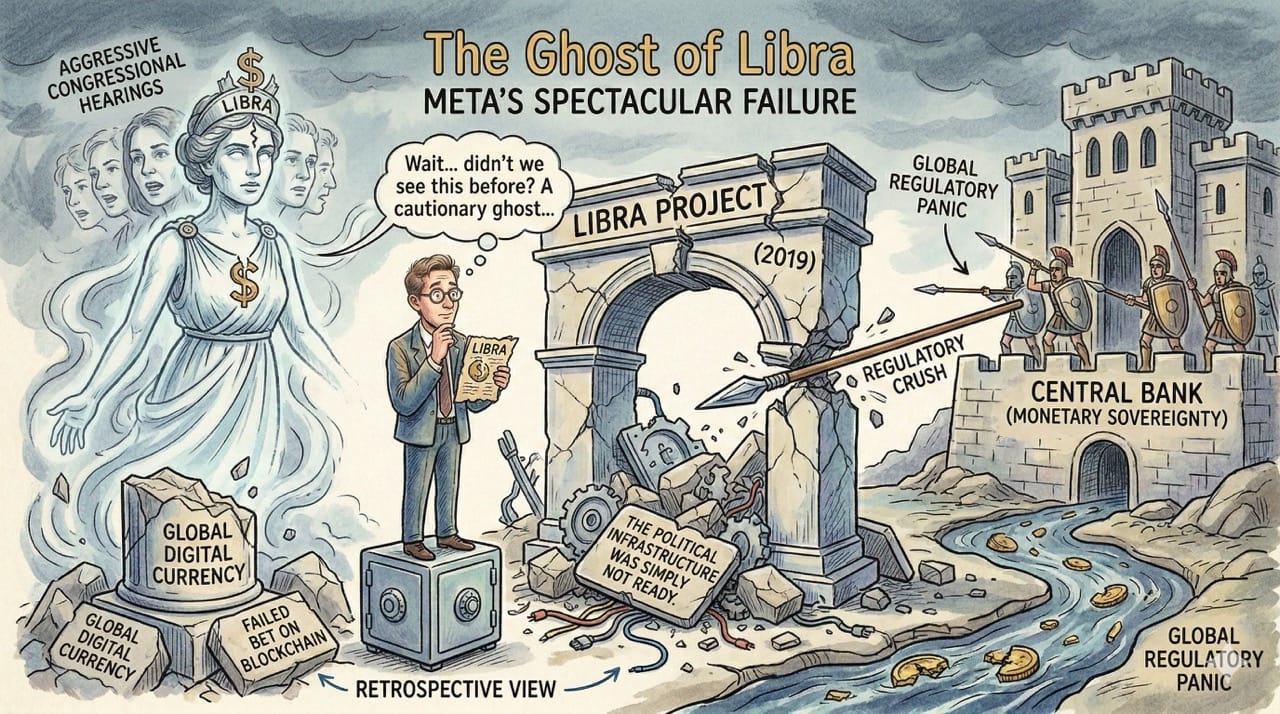
The Ghost of Libra
We have actually seen this exact ambition before.
Meta tried to launch a global digital currency called Libra in 2019.
It was a spectacular failure that ended in aggressive congressional hearings and global regulatory panic.
Governments were absolutely terrified of the project.
They feared that a private corporation with billions of users could threaten the monetary sovereignty of central banks.
Libra was a massive bet on blockchain technology during a time of extreme global uncertainty.
The political infrastructure was simply not ready.
Lawmakers were deeply suspicious of the underlying mechanics, and the project was eventually crushed.
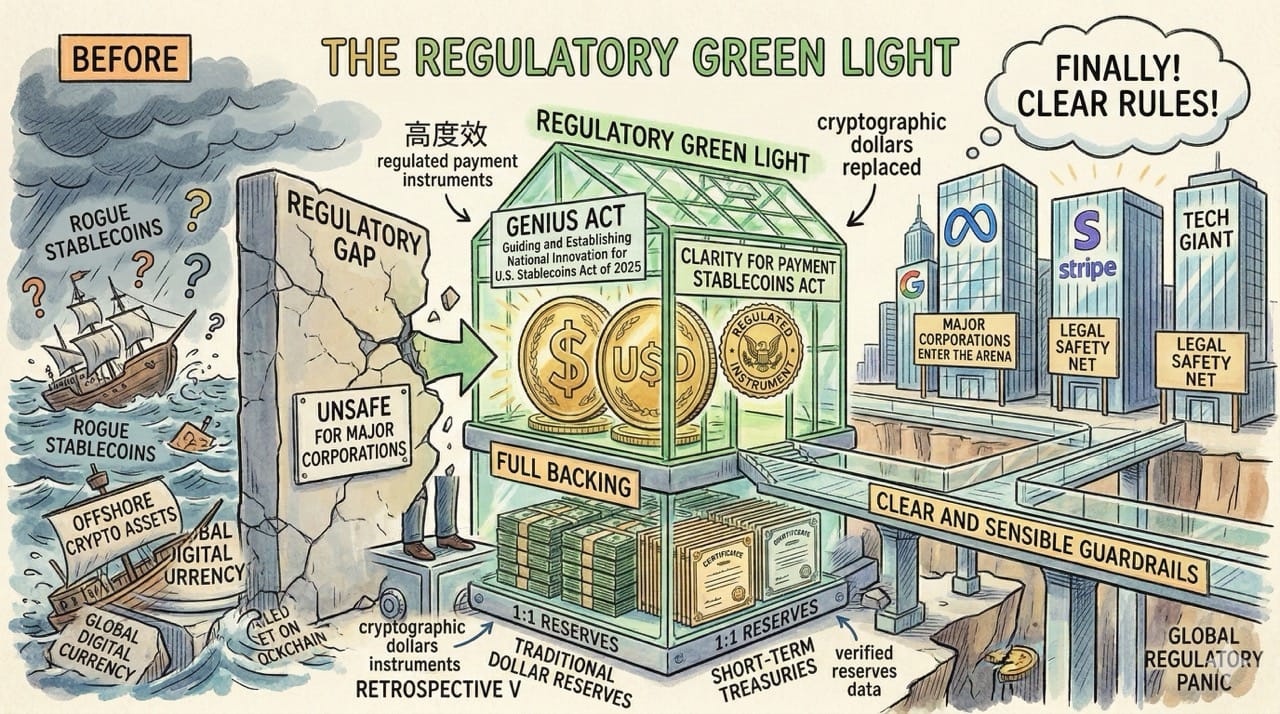
The Regulatory Green Light
Fast forward to today, and the regulatory environment has completely transformed. Legislation like the GENIUS Act and the Clarity for Payment Stablecoins Act established clear and sensible guardrails.
Stablecoins are no longer viewed as rogue, offshore crypto assets.
They are now officially recognized as highly efficient, regulated payment instruments.
They are fully backed by traditional dollar reserves and short-term treasuries.
This regulatory clarity gave massive corporations the legal safety net they needed to finally enter the arena.
The Stripe Validation
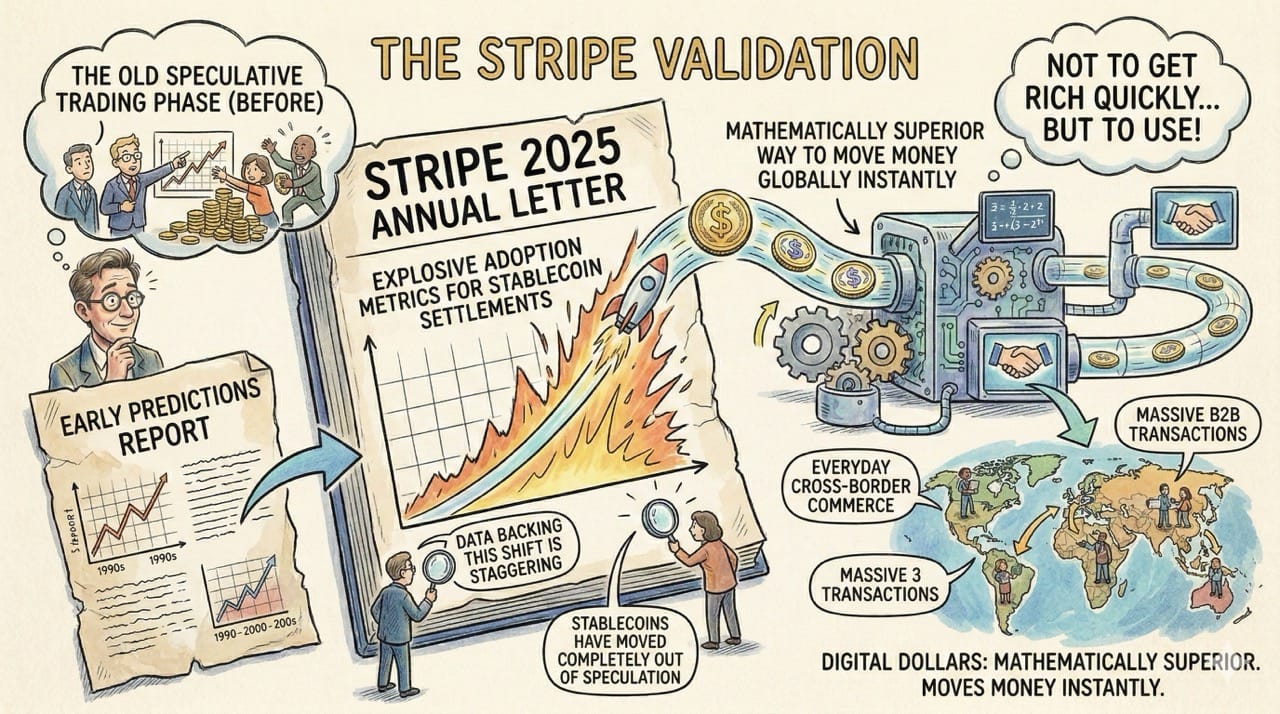
The data backing this shift is absolutely staggering. In their 2025 Annual Letter, Stripe revealed explosive adoption metrics for stablecoin settlements.
They proved that stablecoins have moved completely out of the speculative crypto trading phase.
Digital dollars are now actively used for everyday cross-border commerce and massive B2B transactions.
People are not buying stablecoins to get rich quickly.
They are using them because they are a mathematically superior way to move money across the globe instantly.
The Economic Incentive
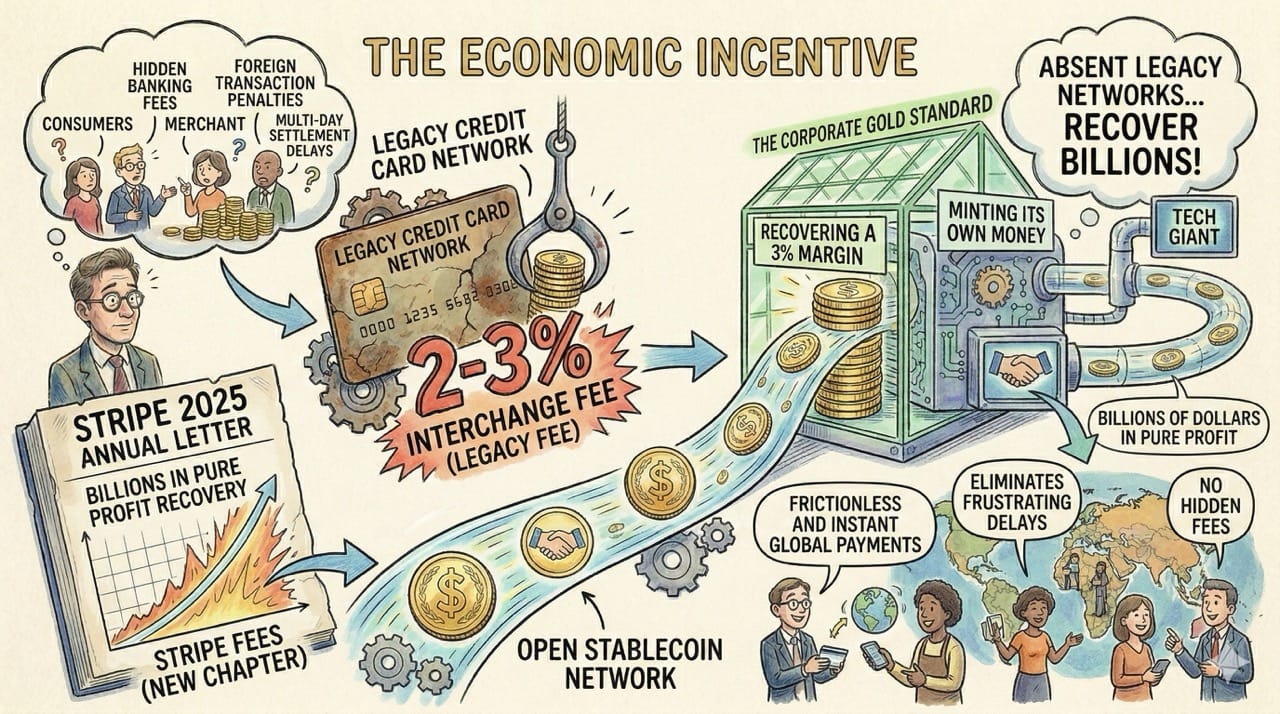
The financial incentive for tech companies to adopt this technology is absolute. Every time you buy something online, legacy credit card networks extract a two to three percent interchange fee.
By issuing their own stablecoins or utilizing open networks, tech giants can bypass these fees entirely.
When you operate at the scale of Amazon or Uber, recovering a three percent margin translates to billions of dollars in pure profit.
For consumers, this means frictionless and instant global payments.
It eliminates hidden banking fees, foreign transaction penalties, and frustrating multi-day settlement delays.
Conclusion: The Evolution of Loyalty
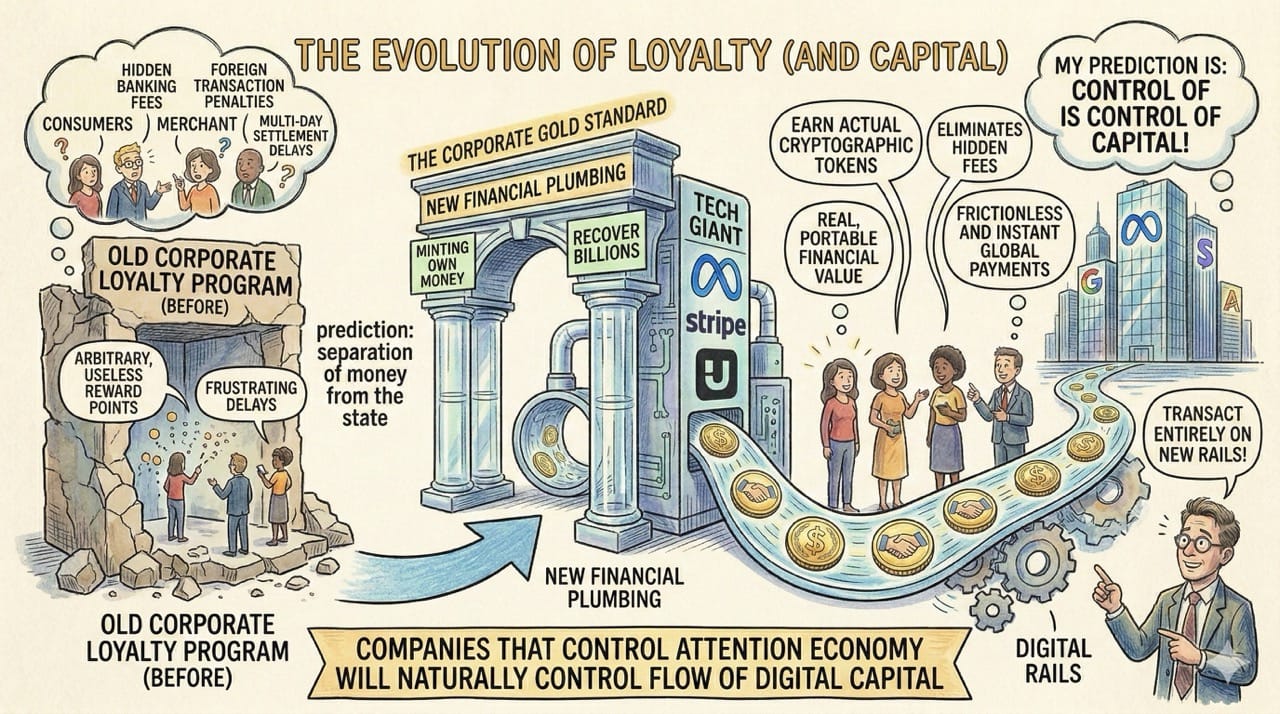
My prediction is that branded stablecoins will completely replace traditional corporate loyalty programs.
You will not earn arbitrary, useless reward points on your purchases.
You will earn actual cryptographic tokens that possess real, portable financial value.
We are watching the separation of money from the state.
The companies that control the attention economy will naturally control the flow of digital capital.
If you want to maximize your finite resources of time and money, you will eventually transact entirely on these new corporate rails.