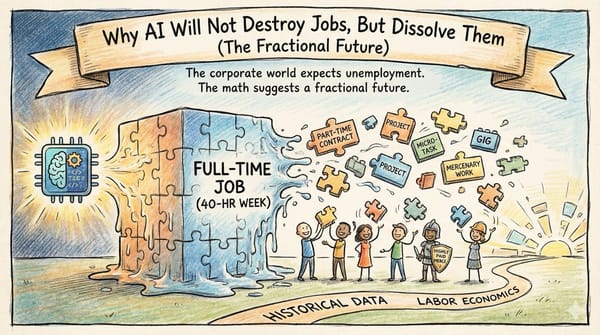
The Asymmetry of Sacrifice: Why Western Game Theory Fails Against Ideology
Western strategy relies on the assumption that every opponent wants to survive. When you fight an adversary who values martyrdom or historical legacy over their own life, all of our mathematical models completely collapse.

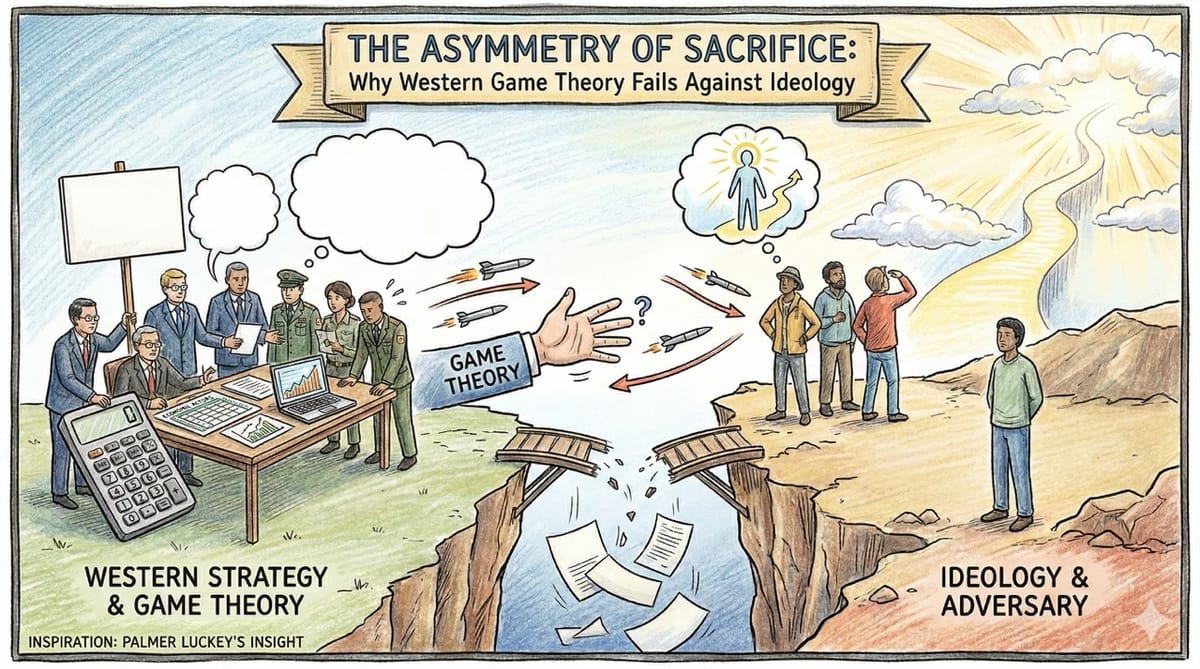
You cannot deter an enemy who does not fear death. The West keeps trying to win ideological wars using economic spreadsheets, and it is failing.
Inspiration: Palmer Luckey's interview on the TBPN podcast. He explained why it is nearly impossible for the West to navigate the Middle East using standard game theory when the adversary believes martyrdom promises a better life.
Game theory is the foundational mathematics of modern Western strategy.
It assumes that all players are rational actors trying to maximize their personal utility.
For a Western politician or general, utility means preserving human life, protecting the economy, and maintaining political power.
We project this exact same psychological framework onto our adversaries.
We assume that if we threaten them with enough military force or economic sanctions, they will rationally choose to surrender.
This is a fatal strategic error.
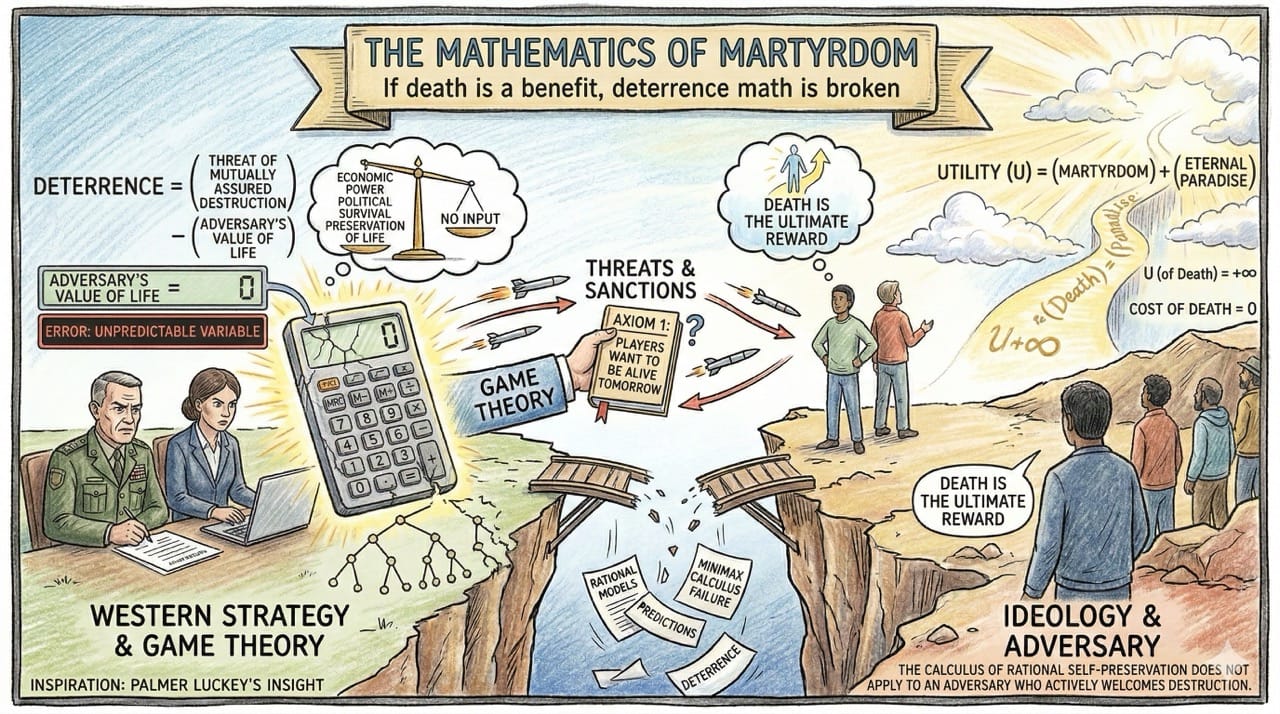
The Mathematics of Martyrdom
If an adversary has a completely different definition of utility, our game theory breaks down. Palmer Luckey highlighted this perfectly regarding the Middle East.
If a fighter genuinely believes that dying in combat guarantees eternal paradise, death is no longer a deterrent.
Death actually becomes the ultimate reward.
You cannot use the threat of mutually assured destruction against someone who actively welcomes destruction.
The math of deterrence only works if both sides actually want to be alive tomorrow.
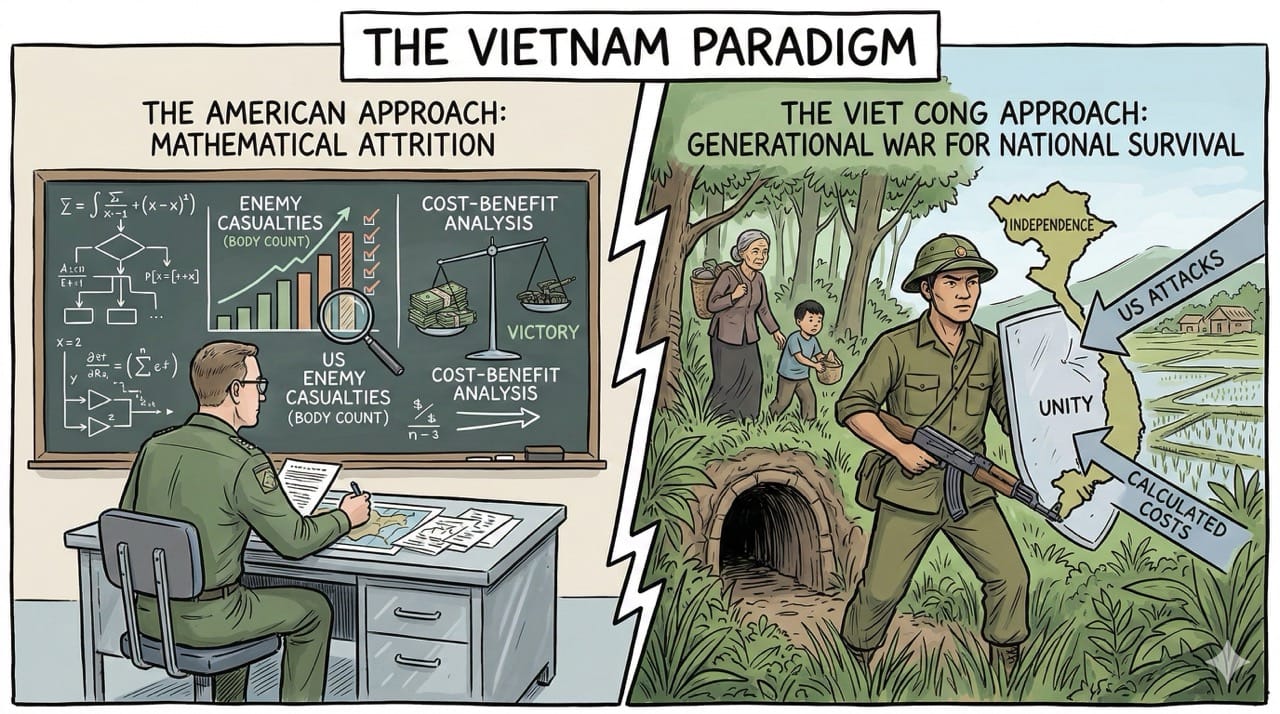
The Vietnam Paradigm
The United States learned this lesson the hard way in Vietnam.
The American military approached the conflict like a sterile mathematical equation.
They relied heavily on body counts and cost-benefit analysis to measure success.
They assumed that if they killed enough Viet Cong fighters, the enemy would eventually realize the cost was too high and surrender.
But the Viet Cong were not fighting a war of attrition.
They were fighting a generational war for national survival, making them immune to standard Western deterrence.
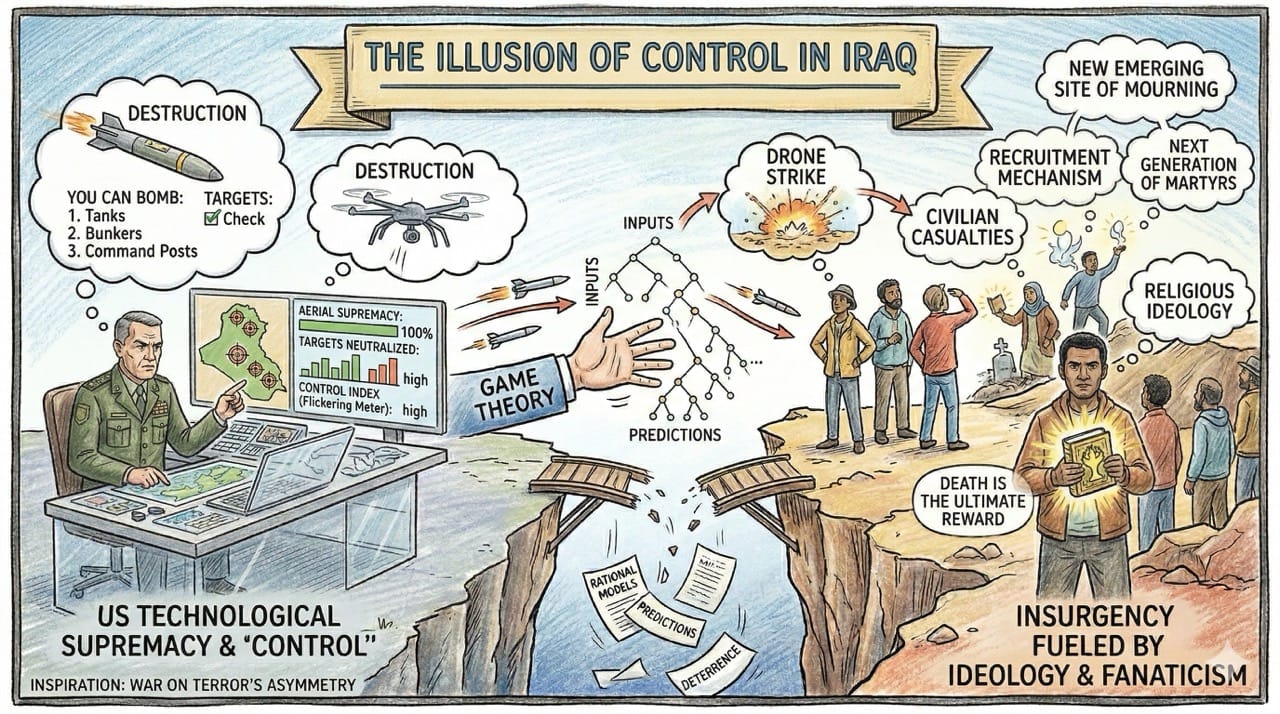
The Illusion of Control in Iraq
This exact same asymmetry played out decades later in Iraq and the broader War on Terror.
The United States possessed absolute technological and aerial supremacy.
They could destroy any conventional military target on earth within hours.
But a smart bomb is completely useless against an ideology.
You cannot bomb an insurgency into submission when the insurgents are fueled by religious fanaticism.
Every drone strike that resulted in civilian casualties simply created a massive recruitment mechanism for the next generation of martyrs.
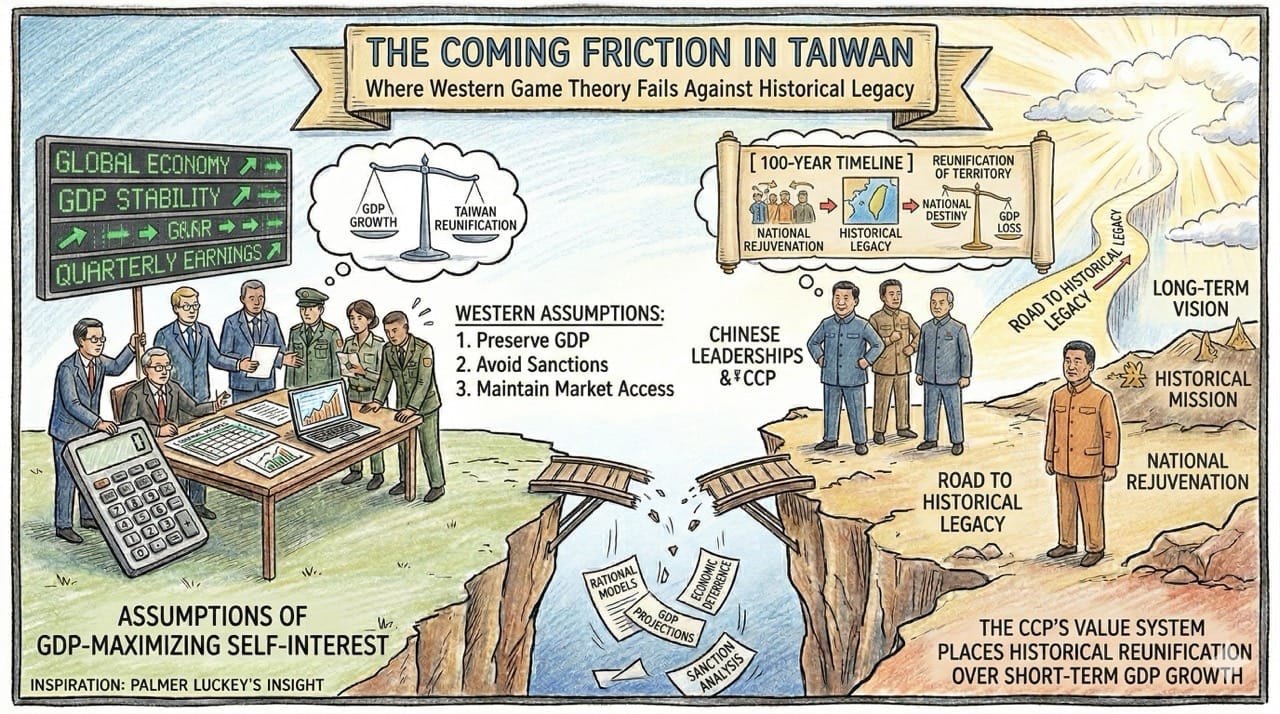
The Coming Friction in Taiwan
This terrifying dynamic is exactly how a potential conflict over Taiwan will likely play out.
Western analysts constantly point out that a Chinese invasion of Taiwan would devastate the global economy.
They assume the Chinese Communist Party will act rationally and avoid the economic suicide of severe Western sanctions.
This is pure Western projection. The Chinese leadership operates on a hundred-year timeline focused on national rejuvenation and historical legacy.
They value the reunification of their territory far more than a temporary drop in their gross domestic product.
If the West tries to deter an invasion using only economic threats and trade tariffs, they will be violently surprised.
The adversary is playing a game of historical destiny, not quarterly earnings.
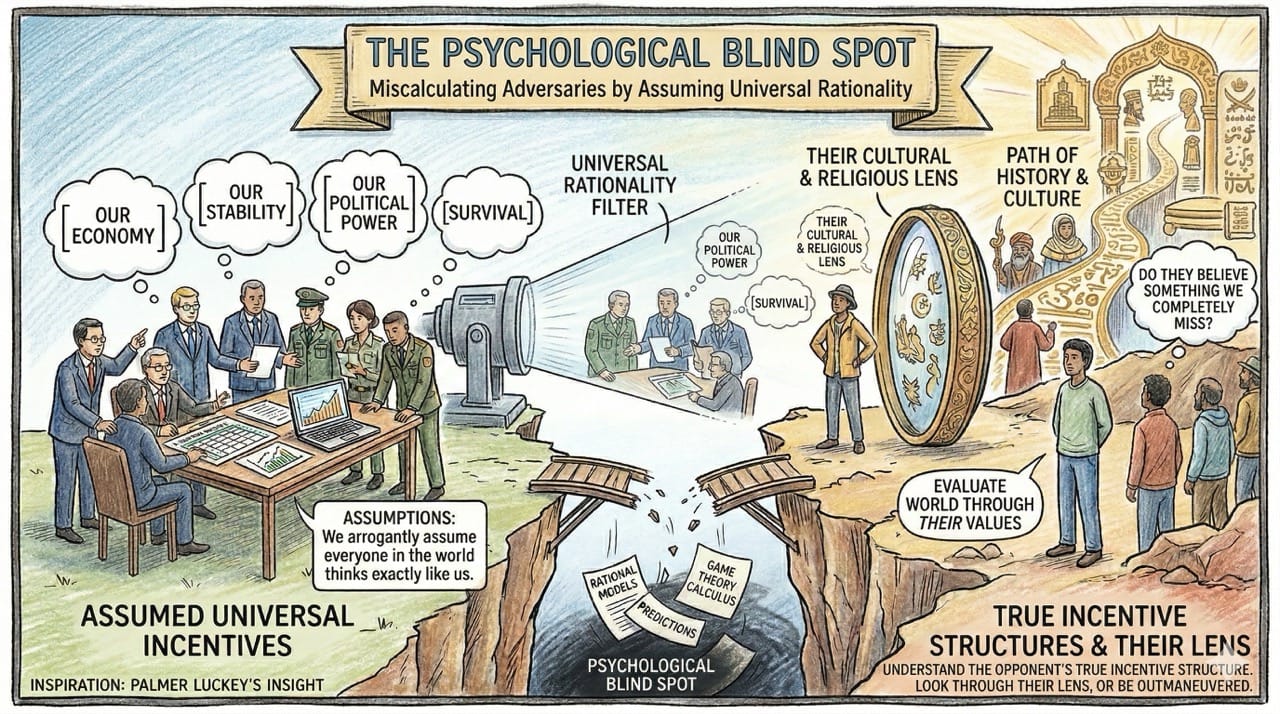
The Psychological Blind Spot
This reveals a massive psychological blind spot for modern democracies. We arrogantly assume that deep down, everyone in the world thinks exactly like us.
We forget the wisdom of assuming that the person you are observing might know or believe something that you completely miss.
To survive in geopolitics, you have to understand the opponent's true incentive structure.
You must evaluate the world through their cultural and religious lens. If you only look at the world through your own values, you will constantly be outmaneuvered.
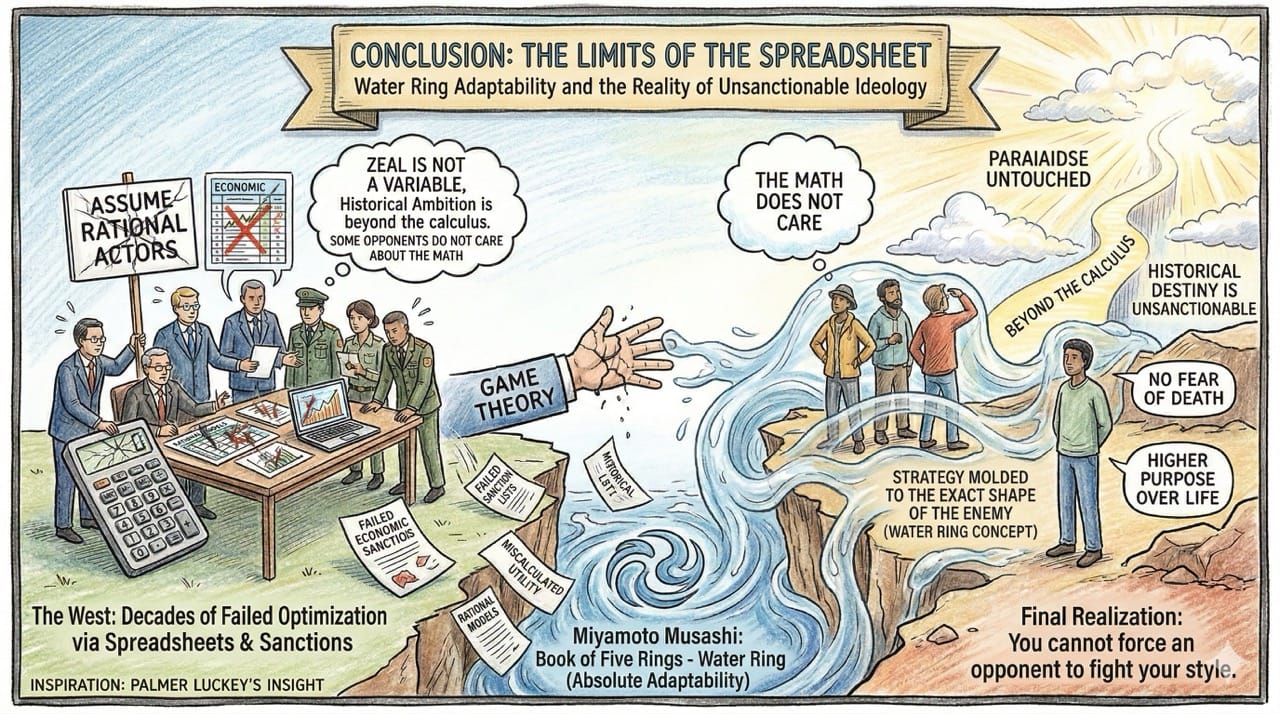
Conclusion: The Limits of the Spreadsheet
In Miyamoto Musashi's Book of Five Rings, the Water Ring teaches the concept of absolute adaptability. You cannot force an opponent to fight your preferred style of war.
You must mold your strategy to fit the exact shape of the enemy you are facing.
The West has spent the last fifty years trying to optimize warfare through spreadsheets and economic sanctions.
But you cannot sanction religious zealotry or historical ambition. We have to realize that some opponents simply do not care about the math.