AI to Boost Luck: The Algorithmic Luck Engine
Luck isn't magic; it's geometry. The old equation was linear. The new AI equation is exponential. Here is how to build a machine that captures opportunity while you sleep.

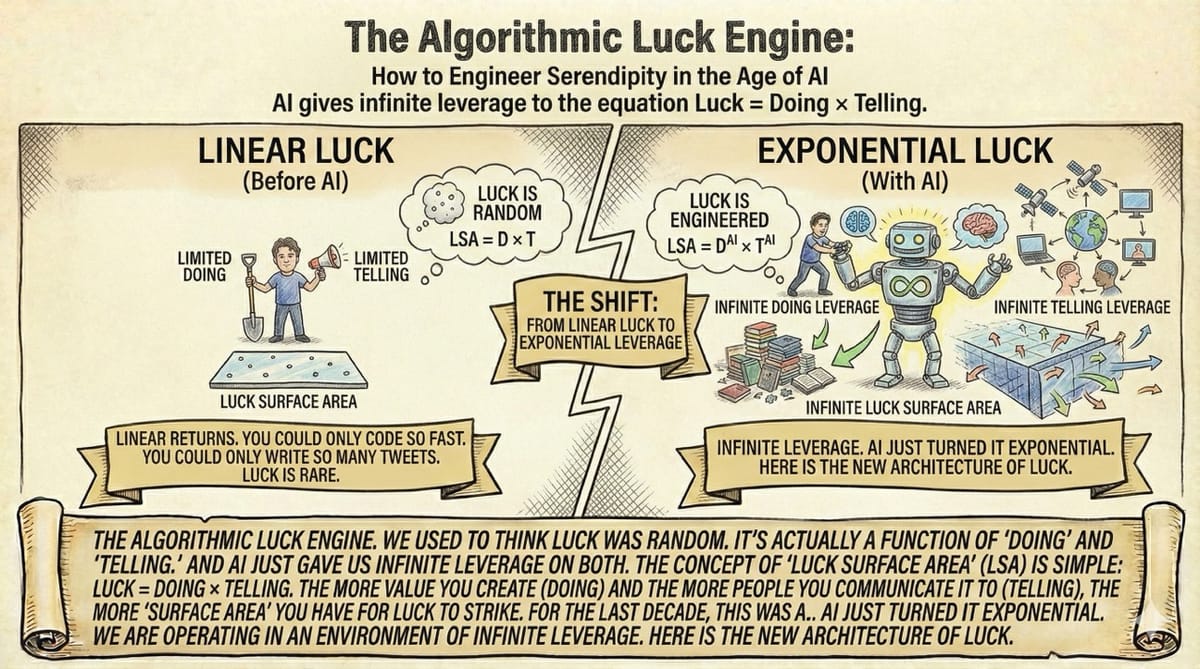
We used to think luck was random. It’s actually a function of "Doing" and "Telling." And AI just gave us infinite leverage on both.
Inspiration: Realizing that a single video translated into 10 languages generates more opportunity in one night than a year of networking events.
This is one of my favourite posts to date. So, I have ben created a video for it (in addition to the detailed explanation below).
The concept of "Luck Surface Area" (LSA) is simple: Luck = Doing × Telling
The more value you create (Doing) and the more people you communicate it to (Telling), the more "surface area" you have for luck to strike.
For the last decade, this was a linear equation. You could only code so fast. You could only write so many tweets.
AI just turned it exponential.
We are no longer operating in an environment of linear returns. We are operating in an environment of infinite leverage. Here is the new architecture of luck.
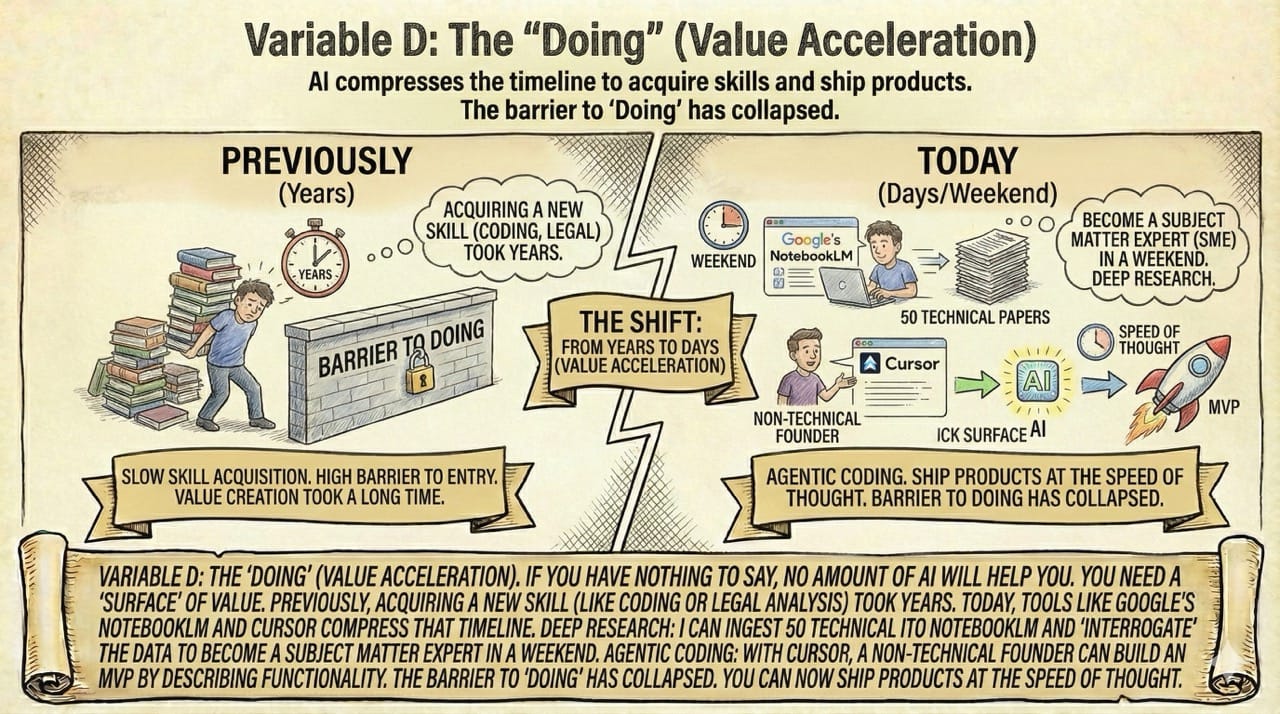
Variable D: The "Doing" (Value Acceleration)
If you have nothing to say, no amount of AI will help you. You need a "surface" of value.
Previously, acquiring a new skill (like coding or legal analysis) took years. Today, tools like Google’s NotebookLM and Cursor compress that timeline.
- Deep Research: I can ingest 50 technical papers into NotebookLM and "interrogate" the data to become a subject matter expert in a weekend.
- Agentic Coding: With Cursor, a non-technical founder can build an MVP by describing functionality.
The barrier to "Doing" has collapsed. You can now ship products at the speed of thought.
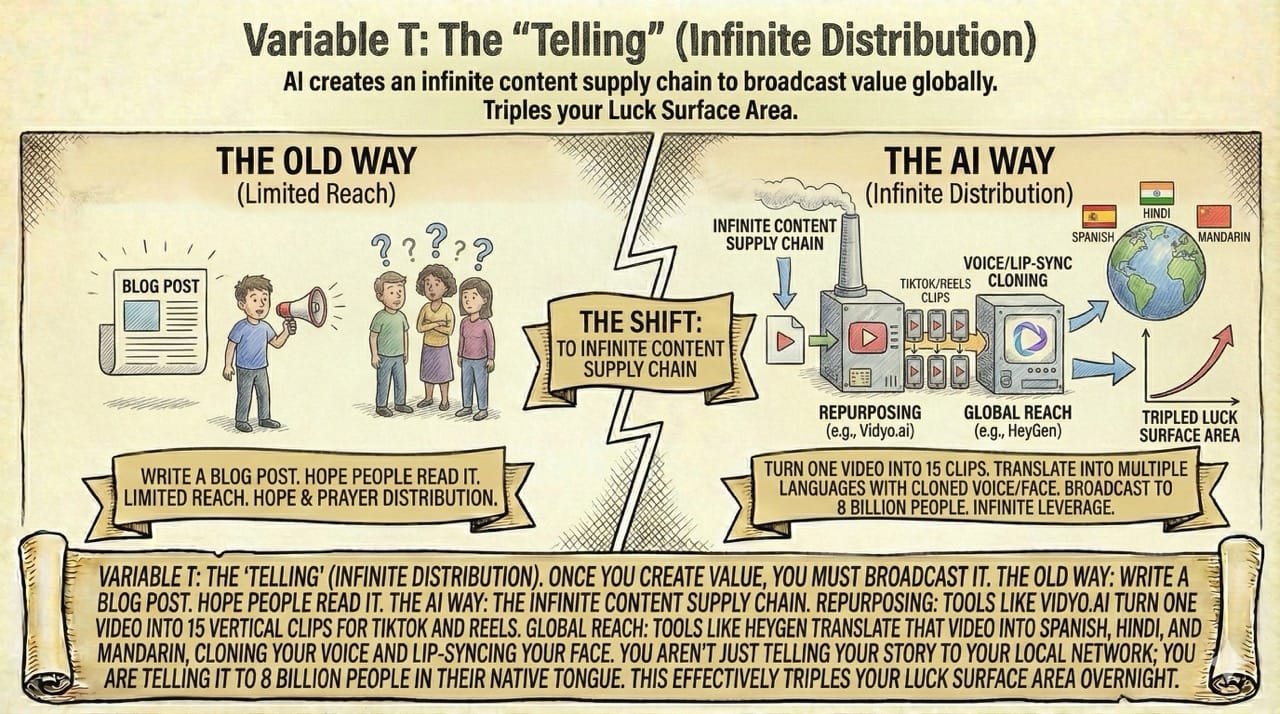
Variable T: The "Telling" (Infinite Distribution)
Once you create value, you must broadcast it.
The old way: Write a blog post. Hope people read it. The AI way: The Infinite Content Supply Chain.
- Repurposing: Tools like Vidyo.ai turn one video into 15 vertical clips for TikTok and Reels.
- Global Reach: Tools like HeyGen translate that video into Spanish, Hindi, and Mandarin, cloning your voice and lip-syncing your face.
You aren't just telling your story to your local network; you are telling it to 8 billion people in their native tongue. This effectively triples your Luck Surface Area overnight.
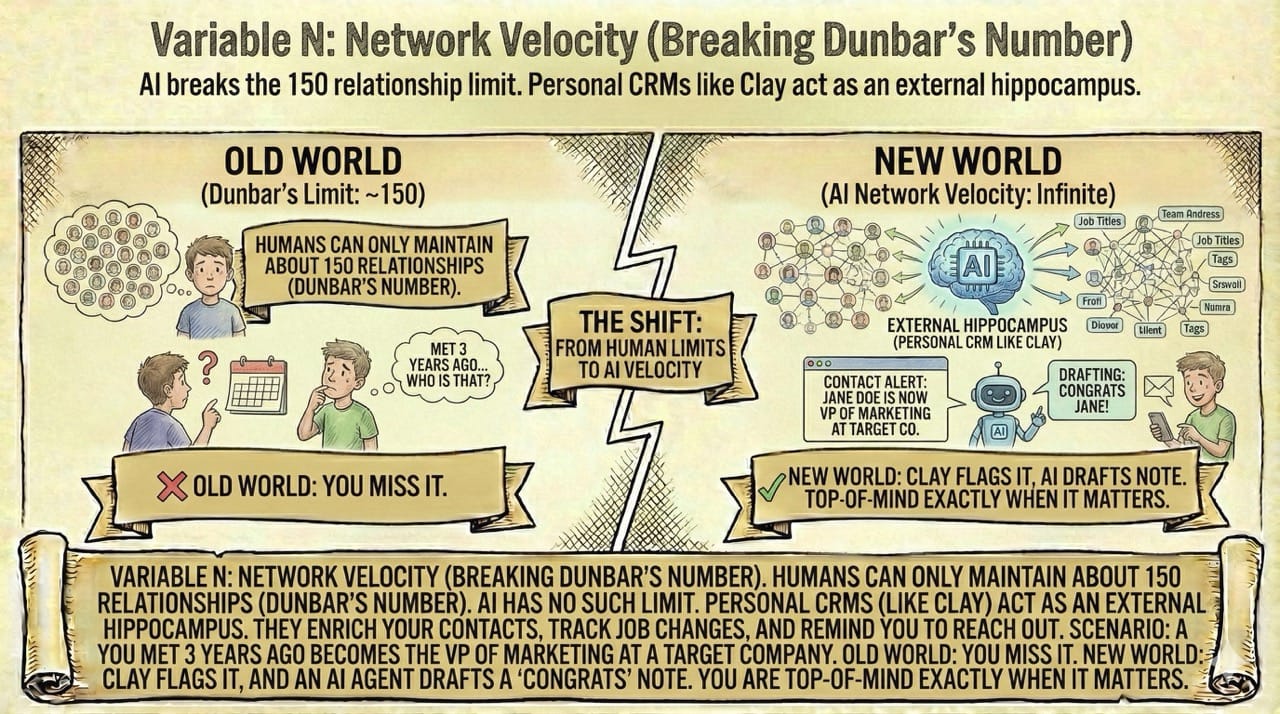
Variable N: Network Velocity (Breaking Dunbar’s Number)
Humans can only maintain about 150 relationships (Dunbar’s Number). AI has no such limit.
Personal CRMs (like Clay) act as an external hippocampus. They enrich your contacts, track job changes, and remind you to reach out.
- Scenario: A contact you met 3 years ago becomes the VP of Marketing at a target company.
- Old World: You miss it.
- New World: Clay flags it, and an AI agent drafts a "Congrats" note. You are top-of-mind exactly when it matters.
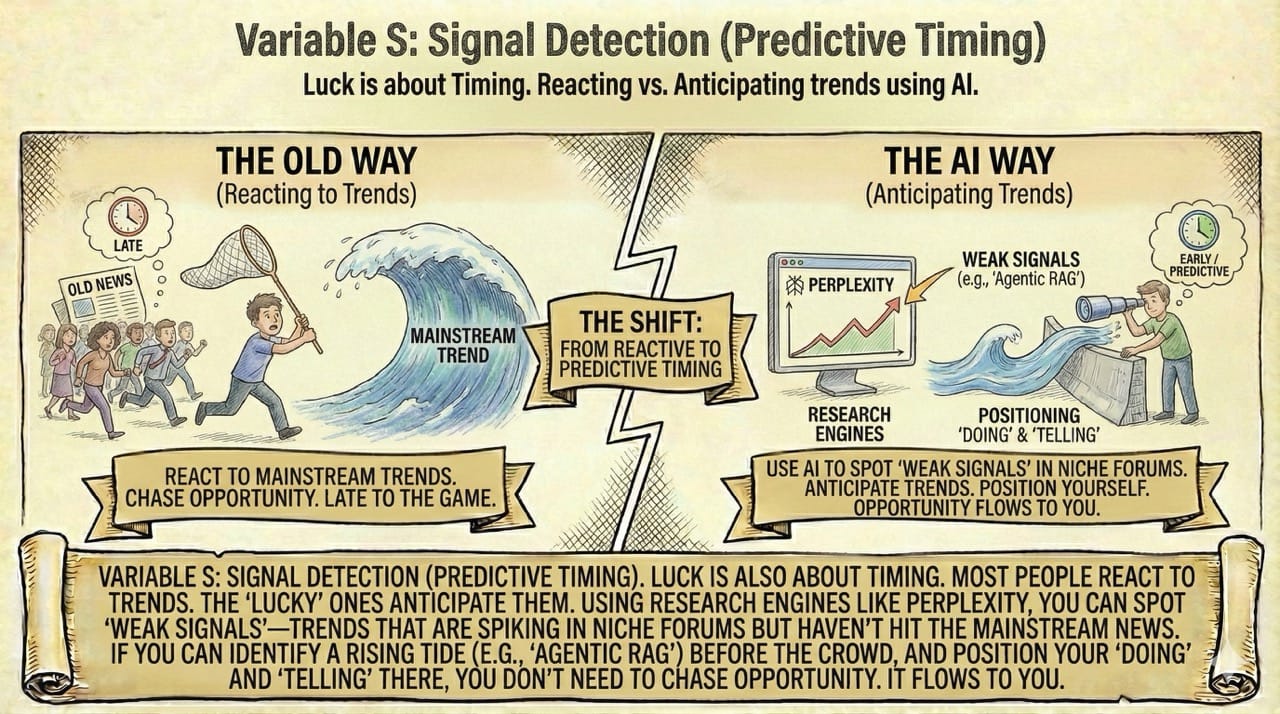
Variable S: Signal Detection (Predictive Timing)
Luck is also about Timing.
Most people react to trends. The "Lucky" ones anticipate them.
Using research engines like Perplexity, you can spot "weak signals"—trends that are spiking in niche forums but haven't hit the mainstream news.
If you can identify a rising tide (e.g., "Agentic RAG") before the crowd, and position your "Doing" and "Telling" there, you don't need to chase opportunity. It flows to you.
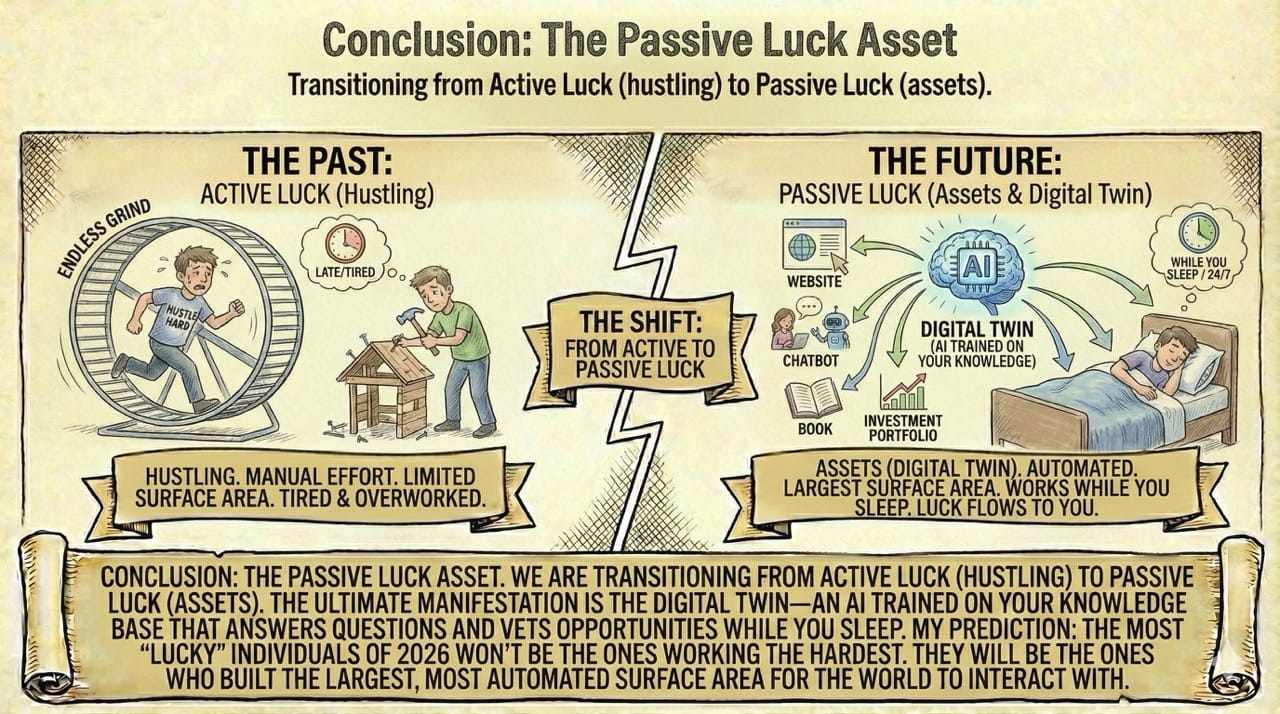
Conclusion: The Passive Luck Asset
We are transitioning from Active Luck (hustling) to Passive Luck (assets).
The ultimate manifestation is the Digital Twin—an AI trained on your knowledge base that answers questions and vets opportunities while you sleep.
My Prediction: The most "lucky" individuals of 2026 won't be the ones working the hardest. They will be the ones who built the largest, most automated surface area for the world to interact with.