Nuclear War: The Risk That Is Ignored

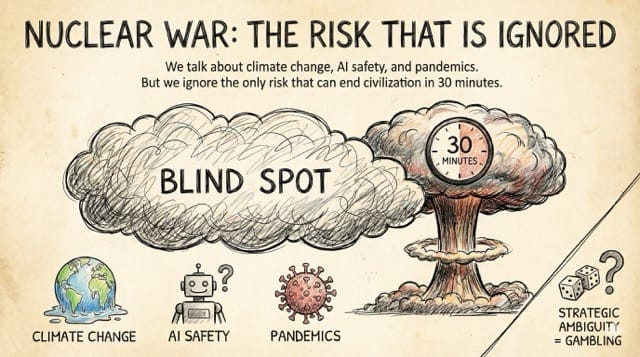
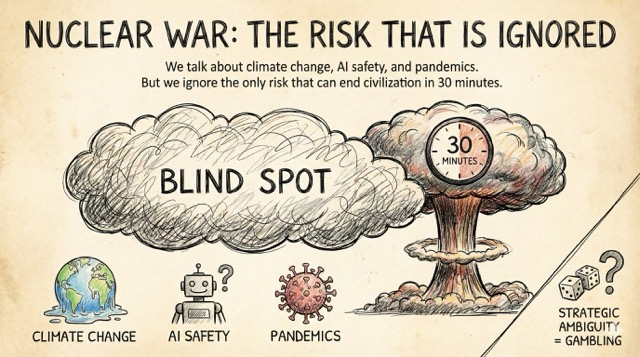
We talk about climate change, AI safety, and pandemics. But we ignore the only risk that can end civilization in 30 minutes.
Inspiration: Reading H.R. McMaster’s At War with Ourselves and realizing that “Strategic Ambiguity” is just a fancy word for gambling.
We have a blind spot.
We obsess over climate change (a slow-motion disaster). We panic about AI safety (a theoretical disaster). We prepare for pandemics (a biological disaster).
But we completely ignore the only risk that can end human civilization in 30 minutes.
The “MAD” Doctrine (A Recap)
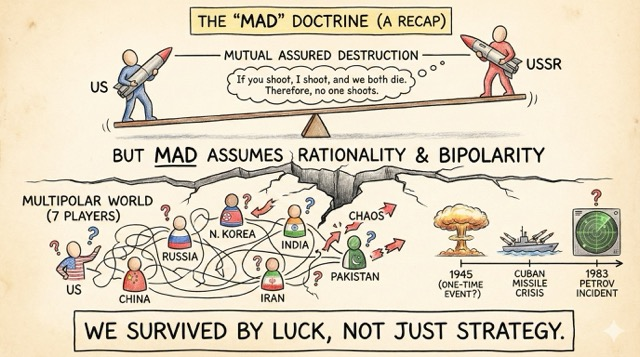
For decades, we relied on Mutual Assured Destruction (MAD). The logic was simple: If you shoot, I shoot, and we both die. Therefore, no one shoots.
But MAD assumes rationality. It assumes a bipolar world (US vs. USSR).
We don’t live in that world anymore. We live in a multipolar world. US, China, Russia, North Korea, Iran, India, Pakistan.
The game theory of 2 players is stable. The game theory of 7 players is chaos.
We think nuclear weapons were a “one-time” event in 1945. We forget the close calls: the Cuban Missile Crisis, the 1983 Petrov incident. We survived by luck, not just strategy.
The “One Trigger” Problem
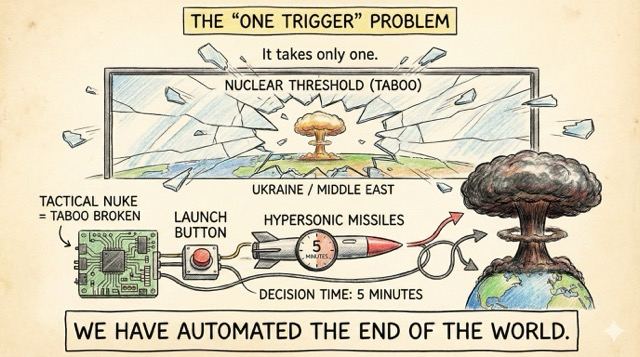
It takes only one.
If a tactical nuke is used in Ukraine or the Middle East, the taboo is broken. The “nuclear threshold” disappears.
In a world of hypersonic missiles, the decision time isn’t 30 minutes anymore. It’s 5 minutes. We have automated the end of the world.
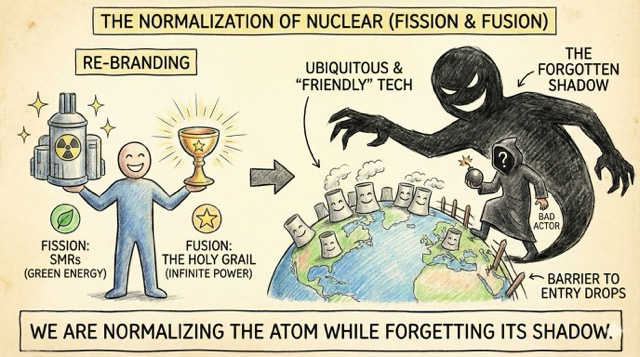
The Normalization of Nuclear (Fusion & Fission)
We are re-branding nuclear.
Fission: Small Modular Reactors (SMRs) are the future of green energy. Fusion: The holy grail of infinite power.
As we make nuclear technology “friendly” and ubiquitous for energy, the underlying technology proliferates. The barrier to entry for “bad actors” drops. We are normalizing the atom while forgetting its shadow.
The Blind Spot (H.R. McMaster)
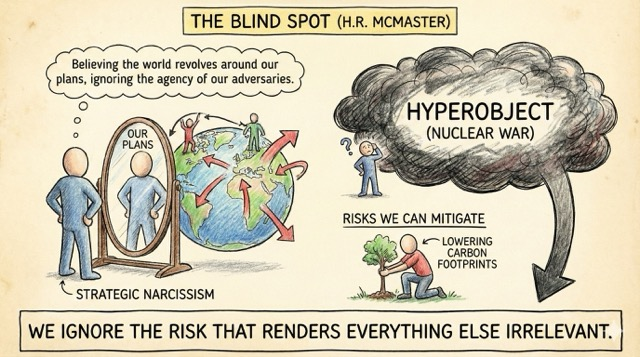
H.R. McMaster argues that the biggest risks are the ones we choose not to see. We suffer from “Strategic Narcissism”—believing the world revolves around our plans, ignoring the agency of our adversaries.
We don’t talk about nuclear war because it is too big to process. It is a “Hyperobject.” So we focus on risks we can mitigate (like lowering carbon footprints) and ignore the risk that renders everything else irrelevant.
Conclusion: The Stoic Response
You cannot build a bunker deep enough. You cannot “prep” for this. Buying iodine tablets is a coping mechanism, not a solution.
The Strategy: Individually, be at peace. Collectively, the only defense is diplomacy and deterrence.
We must stop treating peace as the default setting of history. It is an anomaly. It requires constant, exhausting maintenance.
The moment we take it for granted is the moment the clock strikes midnight.