Google Genie 3 & VR: The Holodeck is Finally Real
We have lived in the era of "Flat" content. With Genie 3, we are entering the era of "Spatial" content. It isn't just about watching a world; it's about inhabiting it.

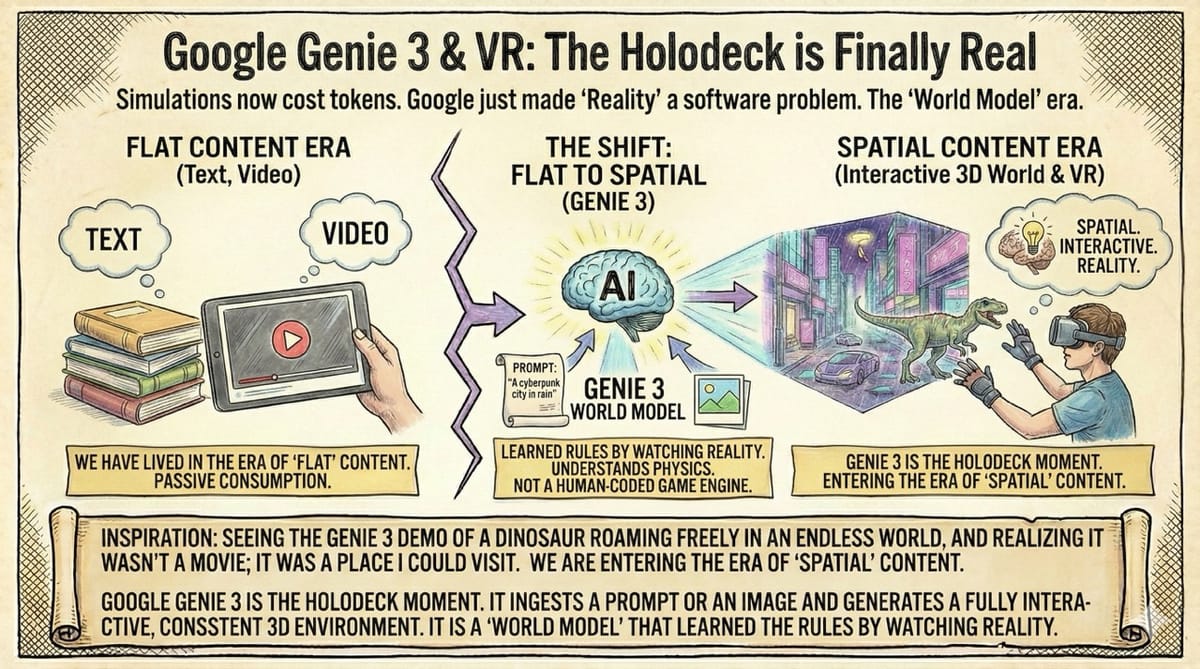
Simulations used to cost millions. Now they cost tokens. Google just made "Reality" a software problem.
Inspiration: Seeing the Genie 3 demo of a dinosaur roaming freely in an endless world, and realizing it wasn't a movie; it was a place I could visit.
We have lived in the era of "Flat" content (text, video). We are entering the era of "Spatial" content.
Google Genie 3 is the Holodeck moment.
Genie 1 was a 2D platformer generator. Genie 3 is a 3D world generator.
It ingests a prompt ("A cyberpunk city in rain") or an image, and it generates a fully interactive, consistent 3D environment. It understands physics. Gravity works. Light reflects.
It isn't a game engine (where a human coded the rules). It is a "World Model" that learned the rules by watching reality.
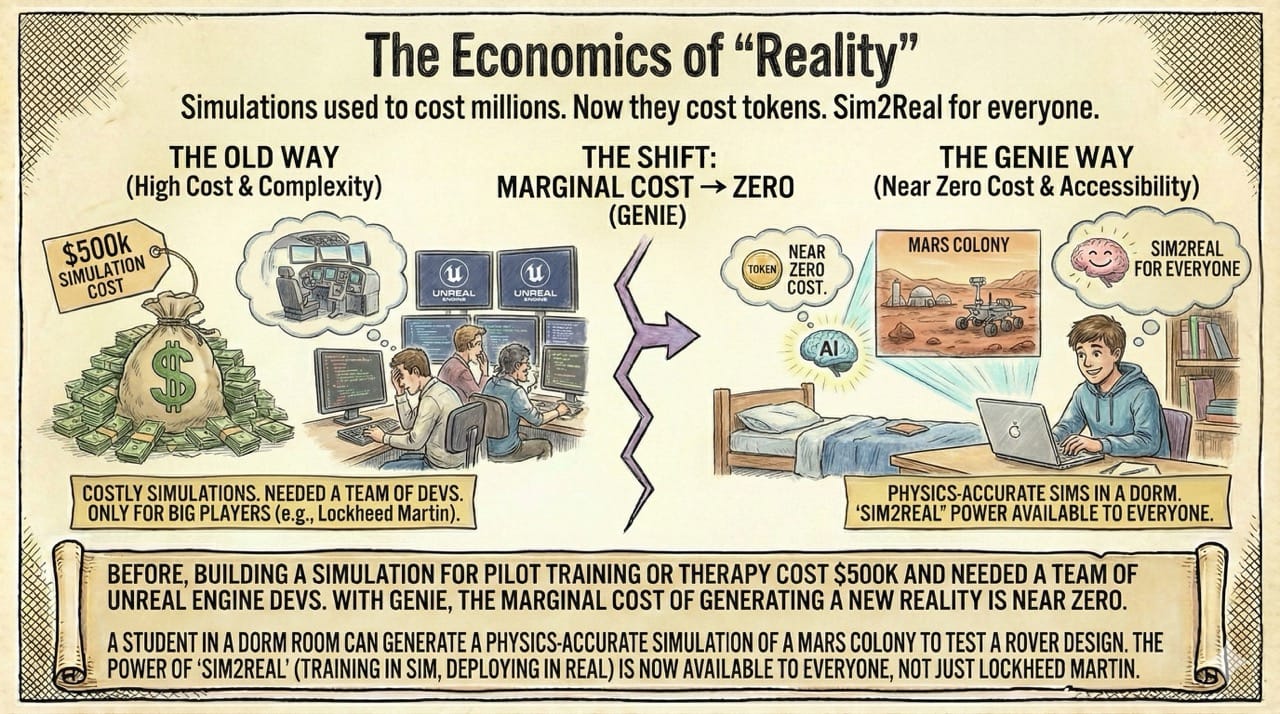
The Economics of "Reality"
Before, building a simulation for pilot training or therapy cost $500k. You needed a team of Unreal Engine devs.
With Genie, the marginal cost of generating a new reality is near zero.
A student in a dorm room can generate a physics-accurate simulation of a Mars colony to test a rover design. The power of "Sim2Real" (training in sim, deploying in real) is now available to everyone, not just Lockheed Martin.
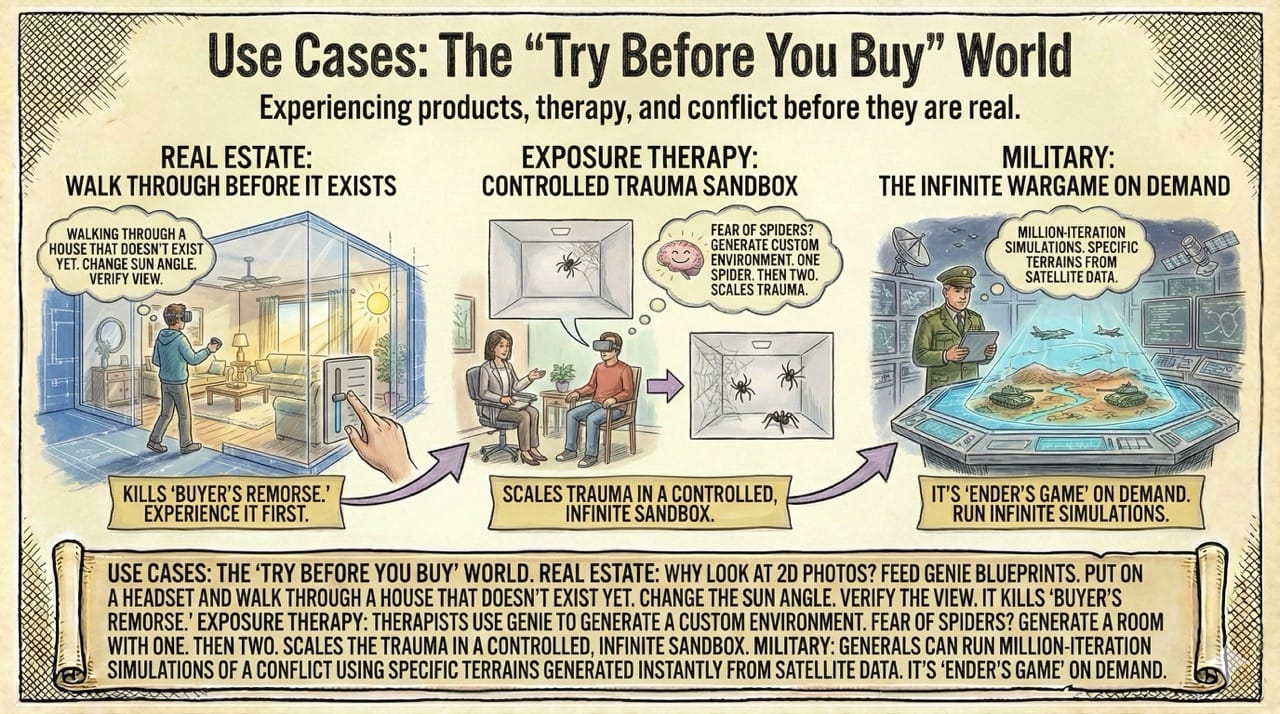
Use Cases: The "Try Before You Buy" World
Real Estate: Why look at 2D photos? You feed Genie the blueprints of a house that doesn't exist yet. You put on a headset and walk through it. You change the sun angle. You verify the view. It kills "Buyer's Remorse."
Exposure Therapy (Mental Health): Therapists currently use expensive, static VR apps. Genie can generate a custom environment. Fear of spiders? It generates a room with one spider. Then two. It scales the trauma in a controlled, infinite sandbox.
Military (The Infinite Wargame): Generals can run million-iteration simulations of a conflict using specific terrains generated instantly from satellite data. It’s "Ender's Game" on demand.
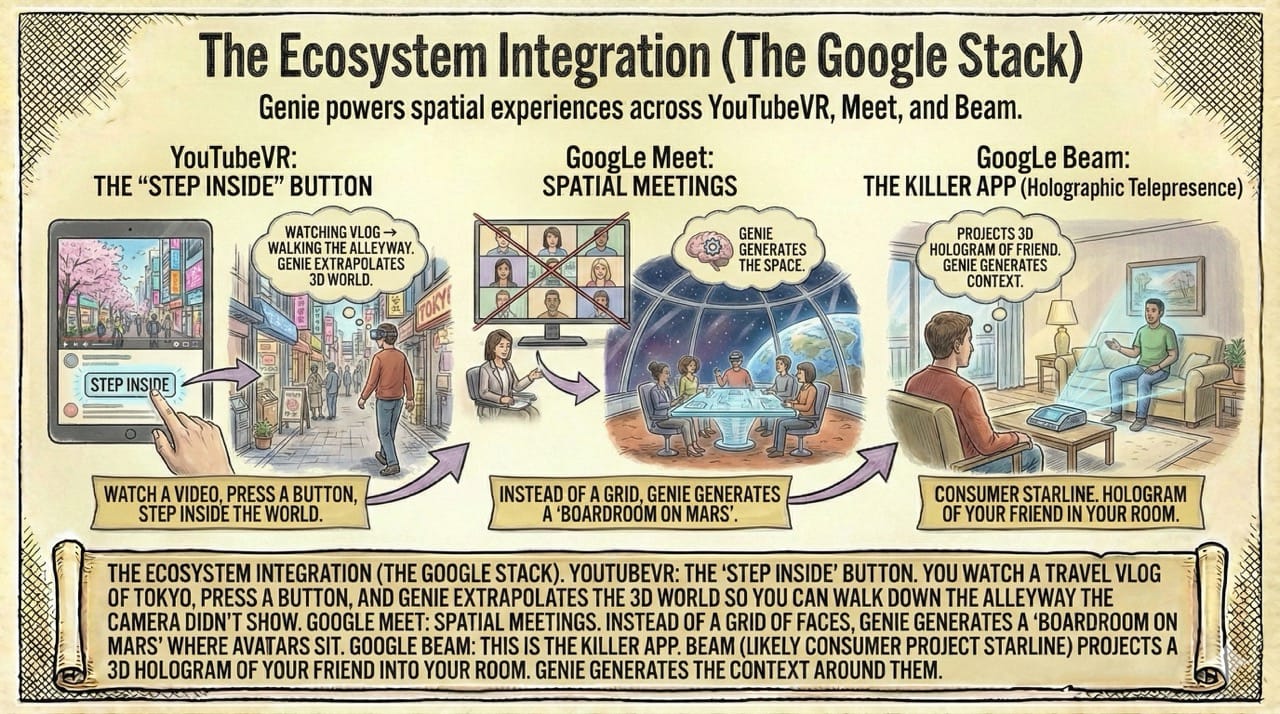
The Ecosystem Integration (The Google Stack)
YouTubeVR: The "Step Inside" button. You watch a travel vlog of Tokyo, press a button, and Genie extrapolates the 3D world so you can walk down the alleyway the camera didn't show.
Google Meet: Spatial meetings. Instead of a grid of faces, Genie generates a "Boardroom on Mars" where avatars sit.
Google Beam: This is the killer app. Beam (formerly known as Project Starline) projects a 3D hologram of your friend into your room. Genie generates the context around them.
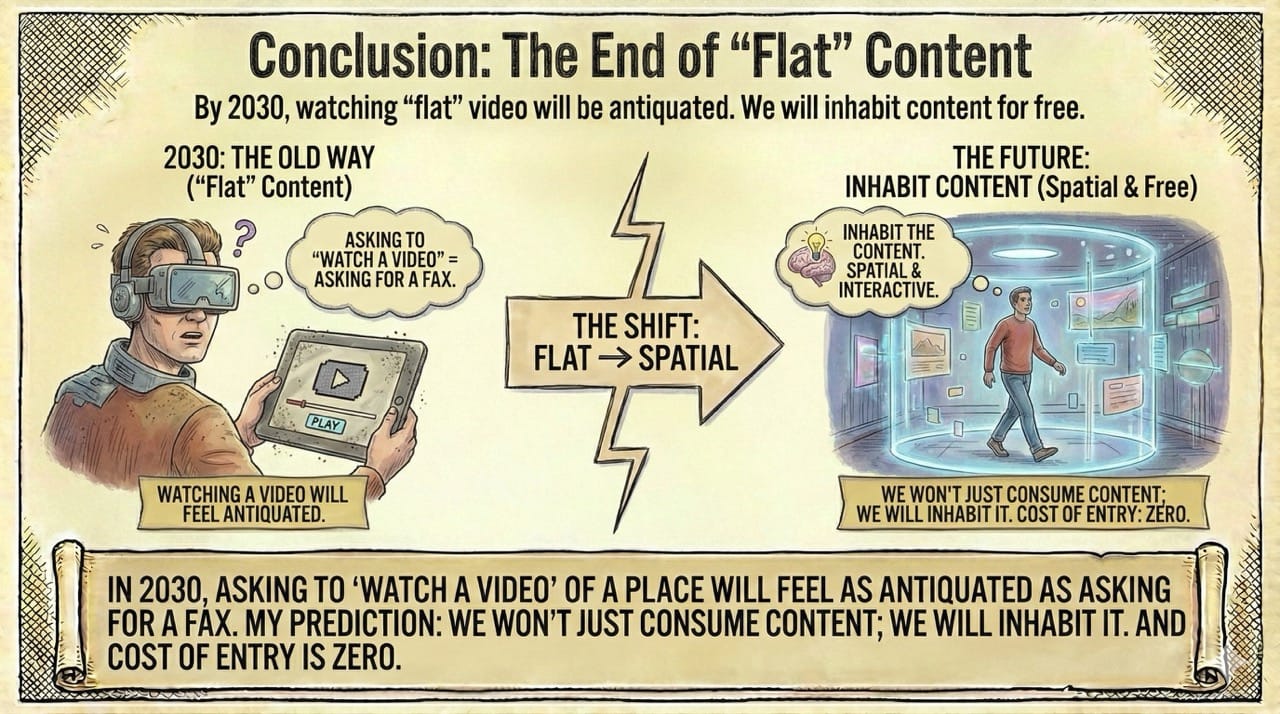
Conclusion: The End of "Flat" Content
In 2030, asking to "watch a video" of a place will feel as antiquated as asking for a fax.
My Prediction: We won't just consume content; we will inhabit it. And the cost of entry is zero.