Geography is Strategy: Why Where You Build Matters More Than What You Build

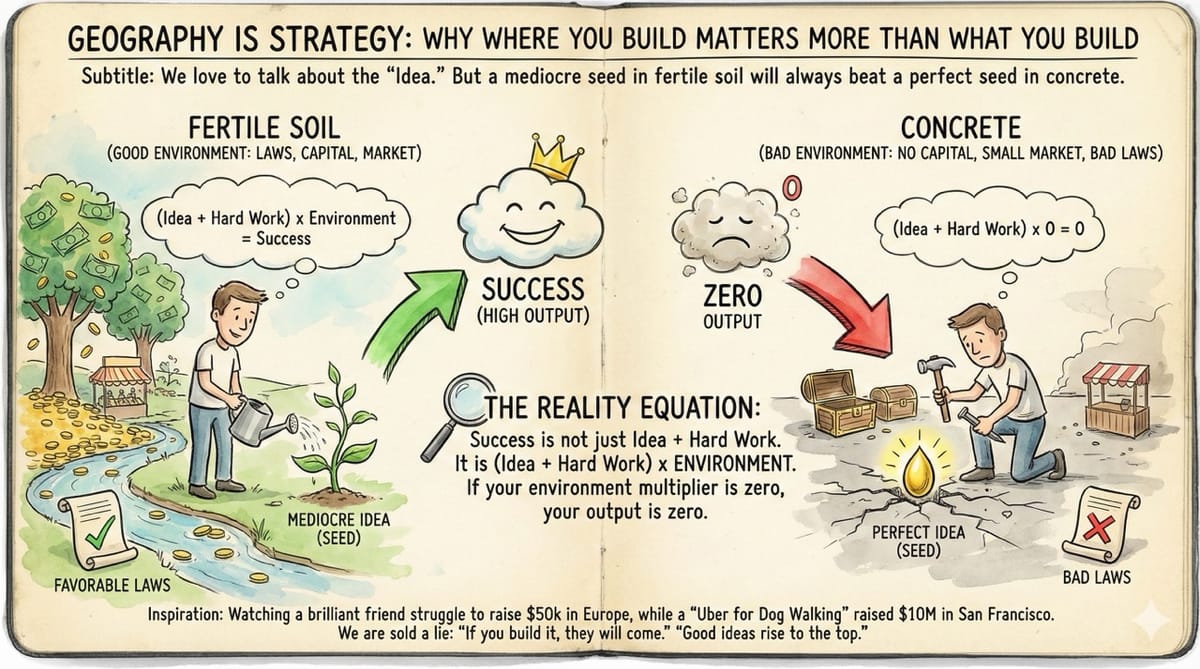
We love to talk about the "Idea." But a mediocre seed in fertile soil will always beat a perfect seed in concrete.
Inspiration: Watching founders struggle to raise $50k in Europe, while a “Uber for Dog Walking” raised $10M in San Francisco.
We are sold a lie: “If you build it, they will come.” “Good ideas rise to the top.”
The reality? Success is not just Idea + Hard Work. It is (Idea + Hard Work) x Environment.
If your environment multiplier is zero (bad laws, no capital, small market), your output is zero.
The Mathematics of TAM (Total Addressable Market)
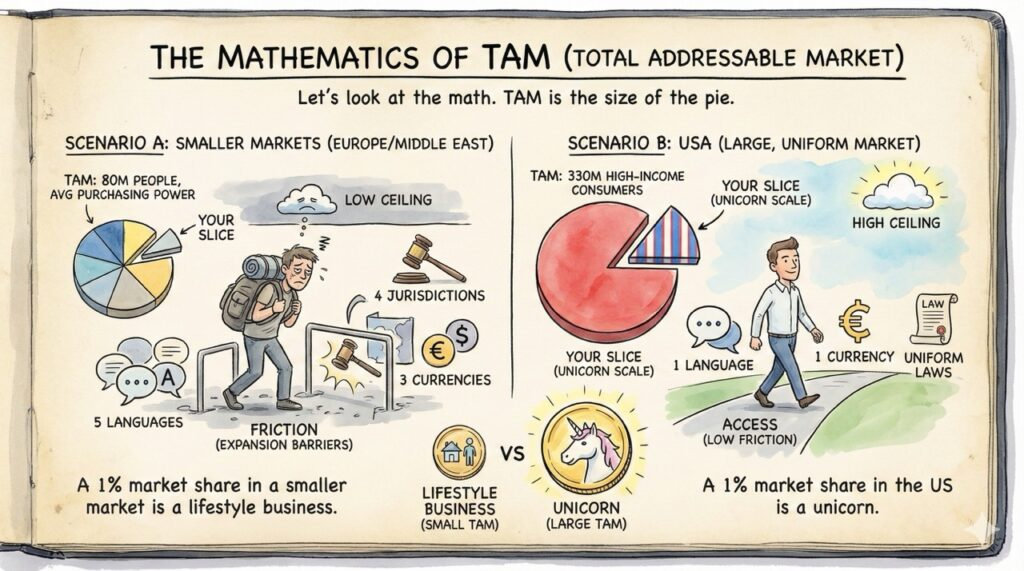
Let’s look at the math. TAM is the size of the pie.
Scenario A (Europe/Middle East): You solve a problem for a country of 80 million people. You speak one language. You have average purchasing power. Your ceiling is low. To expand, you need to translate your app into 5 languages, hire lawyers in 4 jurisdictions, and navigate 3 different currencies. The friction is massive.
Scenario B (USA): You solve the same problem. You instantly have access to 330 million high-income consumers who speak the same language, use the same currency, and operate under (mostly) the same laws.
A 1% market share in the US is a unicorn. A 1% market share in a smaller market is a lifestyle business.
The “Ease of Doing Business” Friction
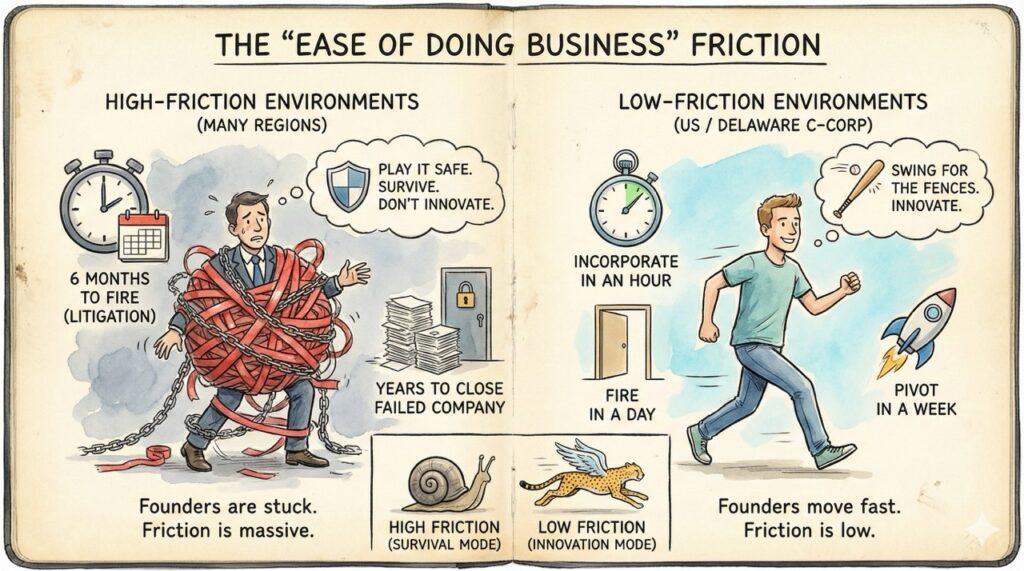
In the US (specifically a Delaware C-Corp), you can incorporate in an hour. You can fire an underperformer in a day. You can pivot in a week.
In many other regions, firing an employee takes 6 months of litigation. Closing a failed company takes years of paperwork.
The result? In high-friction environments, founders play it safe. They don’t innovate; they survive. In low-friction environments, founders swing for the fences.
Access to Capital & The “Failure” Culture
Then there is the money.
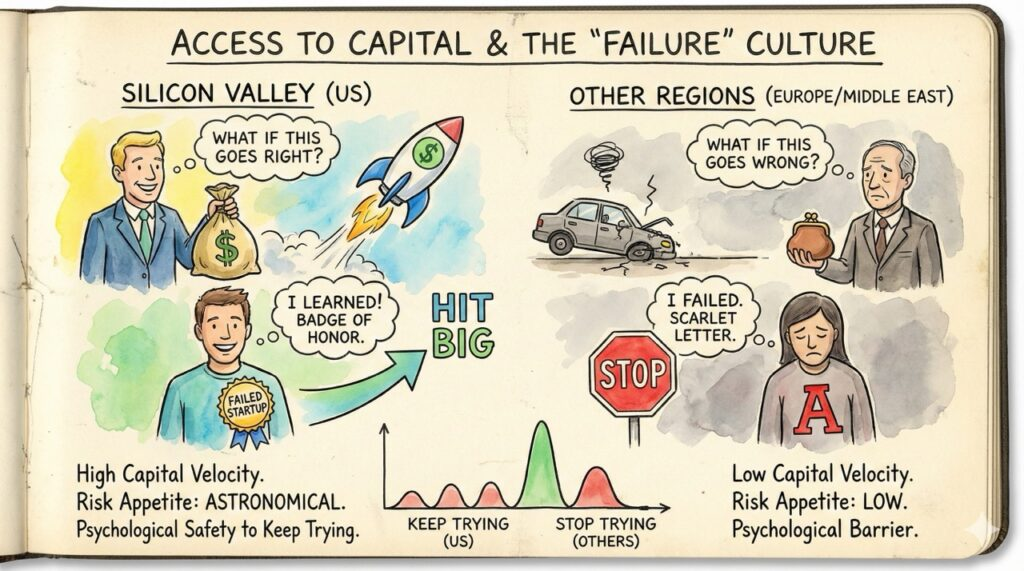
Capital Velocity: In Silicon Valley, investors ask, “What if this goes right?” In Europe or the Middle East, they ask, “What if this goes wrong?”
The difference in risk appetite is astronomical.
In the US, a failed startup is a badge of honor (you learned!). Elsewhere, it’s a scarlet letter (you failed!). This psychological safety allows mediocre US founders to keep trying until they hit big.
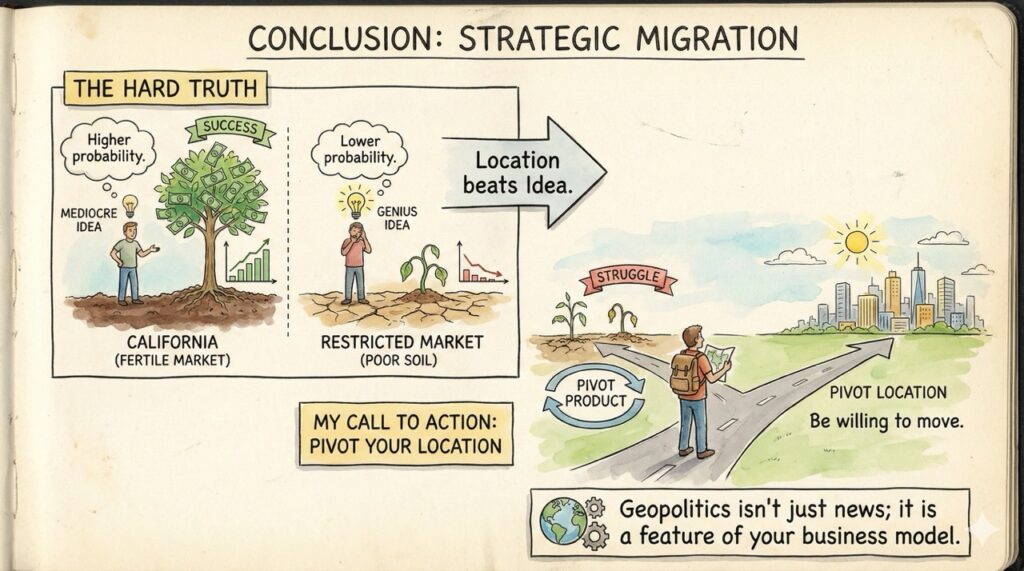
Conclusion: Strategic Migration
Here is the hard truth.
A mediocre idea in California has a higher probability of success than a genius idea in a restricted market.
My Call to Action: Don’t just pivot your product. Be willing to pivot your location.
Geopolitics isn’t just news; it is a feature of your business model.