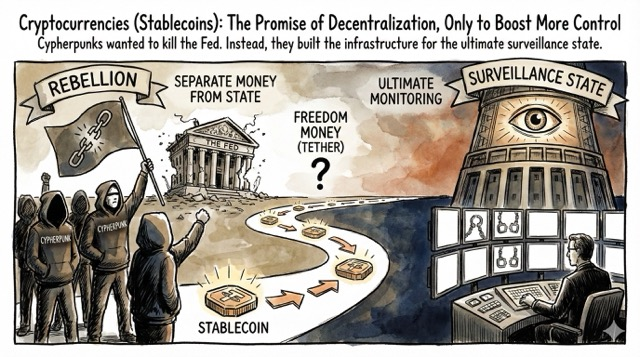
Cryptocurrencies (Stablecoins): The Promise of Decentralization, Only to Boost More Control

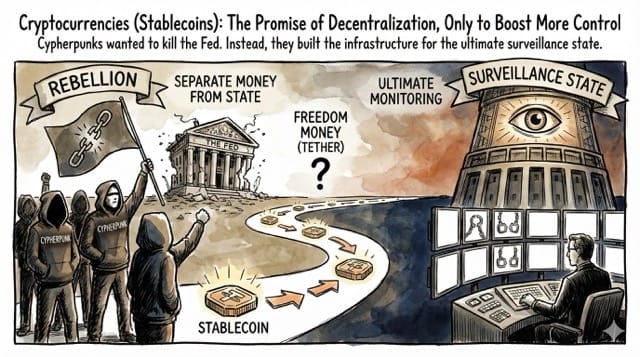
Cypherpunks wanted to kill the Fed. Instead, they built the infrastructure for the ultimate surveillance state.
Inspiration: Realizing that “freedom money” (Tether) is actually the most trackable asset in human history.
Ten years ago, crypto was a rebellion.
It was run by cypherpunks and libertarians. The goal was simple: Separate money from the state. Create a financial system that no government could censor, track, or control.
That dream is dead.
The technology that was promised to liberate us is now being architected to monitor us.
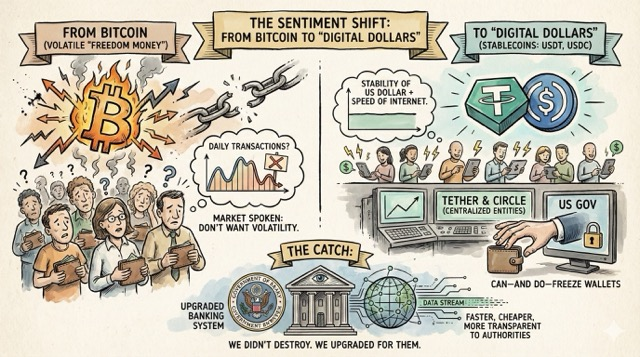
The Sentiment Shift: From Bitcoin to “Digital Dollars”
The market has spoken. People don’t want volatile “freedom money” (Bitcoin) for daily transactions. They want Stablecoins (USDT, USDC).
They want the stability of the US Dollar with the speed of the internet.
But here is the catch: Stablecoins are not decentralized. Tether and Circle (USDC) are centralized entities. They can—and do—freeze wallets at the request of the US government.
We didn’t destroy the banking system. We just upgraded it to be faster, cheaper, and more transparent to the authorities.
The Government’s Dream: Total Visibility
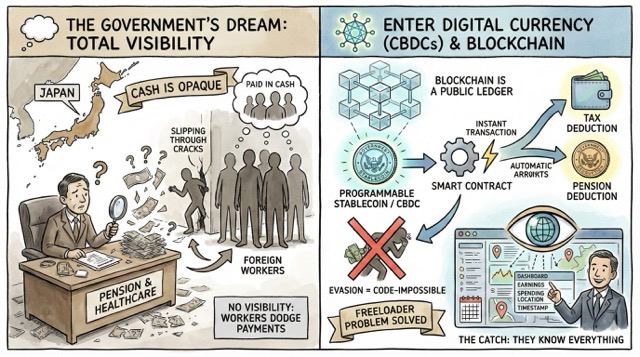
Governments used to fear crypto. Now, they love it. Why? Because cash is opaque. Blockchain is a public ledger.
Let’s look at a real-world friction point: Japan.
Japan struggles with foreign workers dodging mandatory pension and national healthcare payments. Because many are paid in cash or through fragmented banking systems, the government has zero visibility. They slip through the cracks.
Enter Digital Currency (or CBDCs).
If wages are paid via a programmable stablecoin or a state-backed digital currency:
- The transaction happens instantly.
- The “tax” and “pension” portion is automatically deducted by the smart contract before the money even hits the worker’s wallet.
- Evasion becomes code-impossible.
This solves the “freeloader” problem overnight. But it also means the government knows exactly what you earned, where you spent it, and when.
The AI Enforcer: Palantir & The End of Privacy
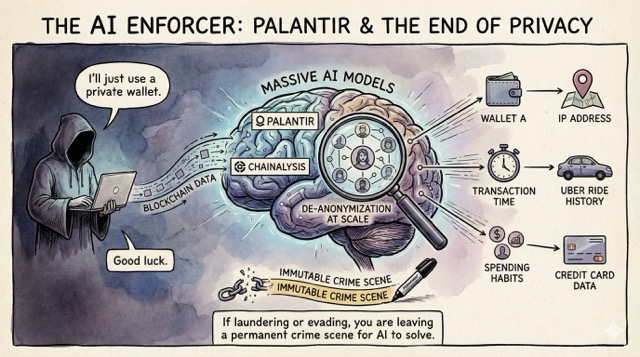
You might think, “I’ll just use a private wallet.”
Good luck.
We are entering the era of AI-Forensics. Companies like Palantir and Chainalysis are feeding blockchain data into massive AI models.
These models don’t just see “Wallet A sent money to Wallet B.” They see the pattern.
- They link your wallet to your IP address.
- They link your transaction time to your Uber ride history.
- They link your spending habits to your credit card data.
The result? De-anonymization at scale.
If you are trying to launder money or evade taxes on a blockchain, you are effectively leaving a permanent, immutable crime scene for an AI to solve 5 years from now.
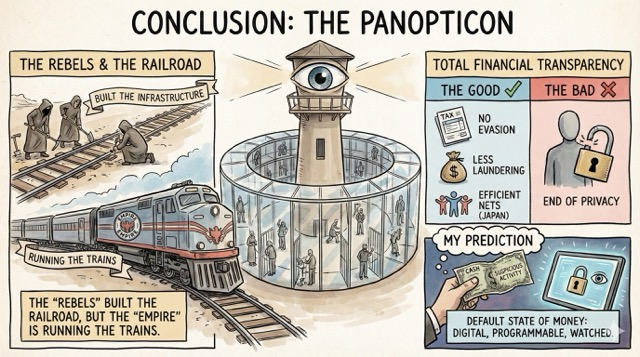
Conclusion: The Panopticon
The “Rebels” built the railroad, but the “Empire” is running the trains.
We are moving toward a world of total financial transparency.
- The Good: No more tax evasion, less money laundering, and efficient social safety nets (like in Japan).
- The Bad: The end of financial privacy.
My Prediction: In the future, “Cash” will be viewed as a suspicious activity. The default state of money will be digital, programmable, and watched.