China’s Latest Military Purge: Is the Tiger Sick, or Just Sharpening Its Claws?
The removal of high-ranking military officials like Gen. Zhang Youxia signals a significant shift in Beijing. It prioritizes internal alignment over continuity, creating a period of uncertainty.

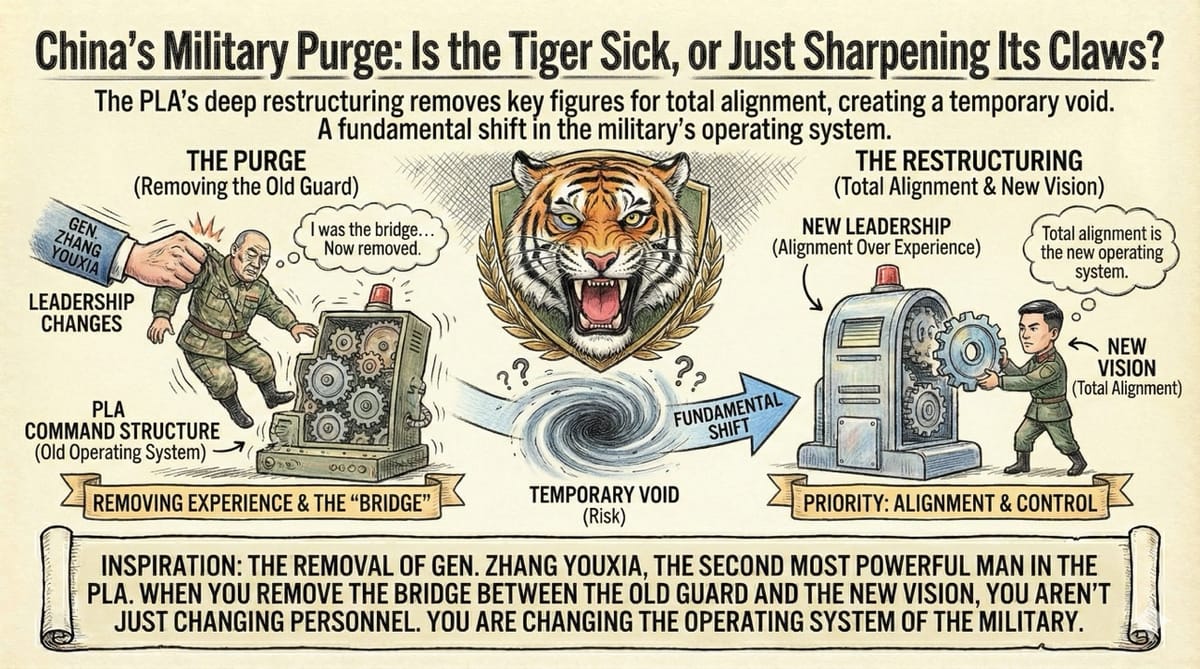
The recent leadership changes in the PLA reveal a deep restructuring. Removing key figures prioritizes alignment over experience, but it also creates a temporary void.
Inspiration: The significant news that Gen. Zhang Youxia—the second most powerful man in the PLA—has been removed from his post.
We thought the leadership changes were focused solely on the Rocket Force. We were wrong.
The news this week that Gen. Zhang Youxia, Vice Chairman of the Central Military Commission, has been removed is a major development.
Zhang wasn't just a general. He was the highest-ranked PLA commander in the country. His departure signals a fundamental shift in how the leadership structure is being organized. It suggests a move toward total alignment within the command structure.
When you remove the bridge between the old guard and the new vision, you aren't just changing personnel. You are changing the operating system of the military.
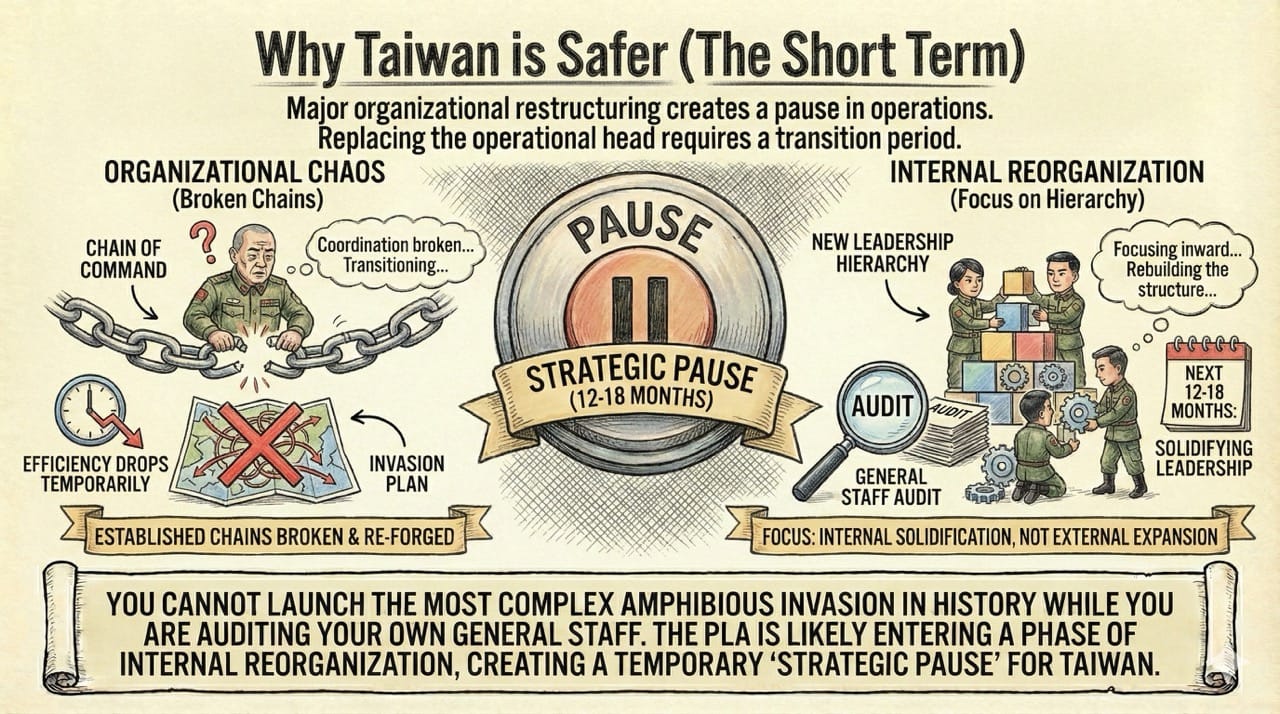
Why Taiwan is Safer (The Short Term)
Major organizational restructuring creates a pause in operations.
Replacing the operational head of the military requires a transition period. The complex coordination required for any large-scale operation relies on established chains of command. When those chains are broken and re-forged, efficiency drops temporarily.
The "Strategic Pause": The PLA is likely entering a phase of internal reorganization. For the next 12 to 18 months, the focus will be on solidifying the new leadership hierarchy rather than external expansion. You cannot launch the most complex amphibious invasion in history while you are auditing your own general staff.
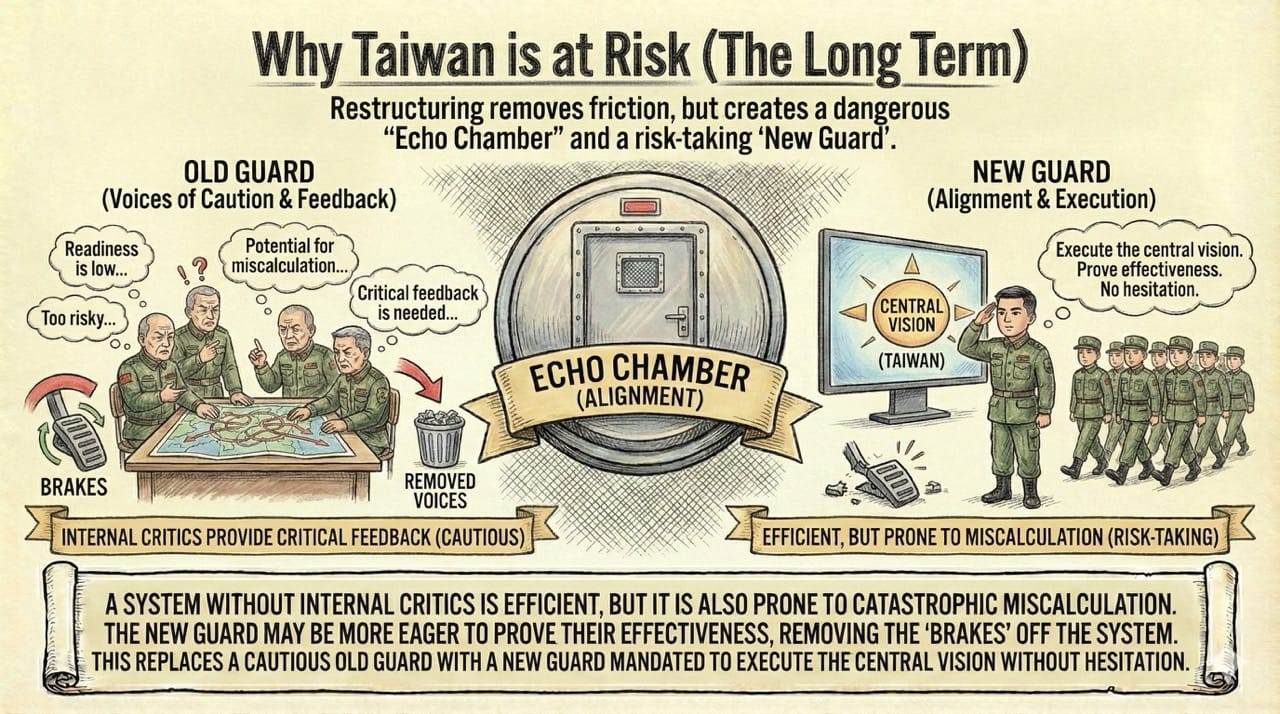
Why Taiwan is at Risk (The Long Term)
This restructuring could remove internal friction.
By replacing established figures with newer leaders who are more strictly aligned with the central vision, Beijing removes potential voices of caution.
The Echo Chamber Risk: Experienced leaders often provide critical feedback on readiness. If the new leadership is chosen primarily for alignment, that feedback loop may be broken. A system without internal critics is efficient, but it is also prone to catastrophic miscalculation.
The New Guard: The new commanders may be more eager to prove their effectiveness and commitment to the national strategy. This removes the "brakes" off the system. It replaces a potentially cautious old guard with a new guard that is mandated to execute the central vision without hesitation.
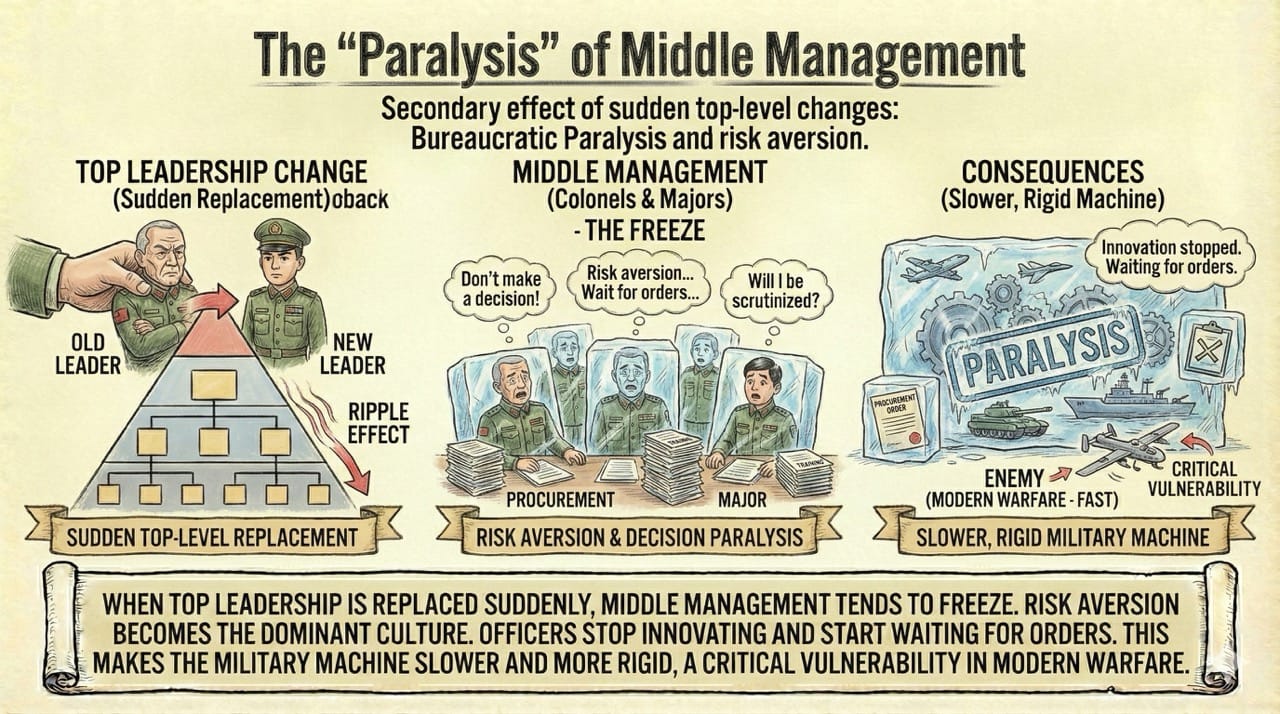
The "Paralysis" of Middle Management
There is a secondary effect to these high-level changes: Bureaucratic Paralysis.
When top leadership is replaced suddenly, the middle management (Colonels and Majors) tends to freeze. No one wants to make a decision, sign a procurement order, or approve a training exercise that might be scrutinized later.
Risk aversion becomes the dominant culture. Officers stop innovating and start waiting for orders. This makes the military machine slower and more rigid in the medium term. In modern warfare, where decision loops happen in minutes, this rigidity is a critical vulnerability.
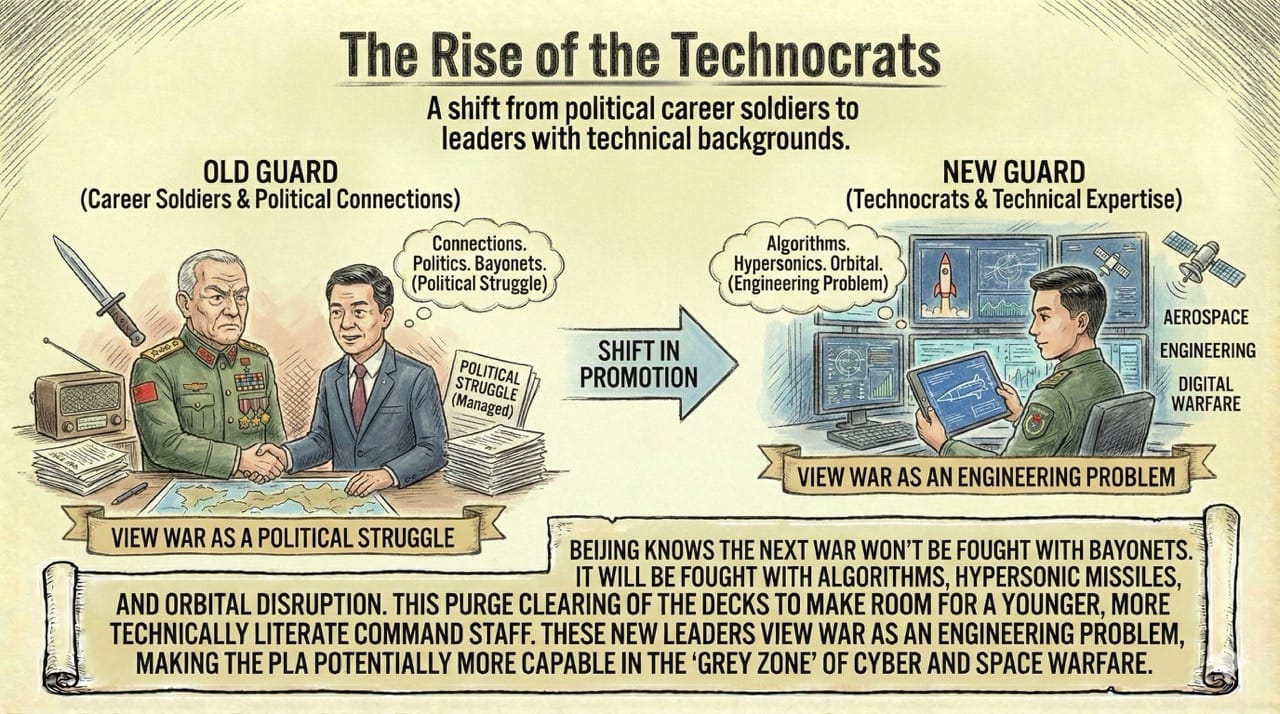
The Rise of the Technocrats
We are also likely seeing a shift in who gets promoted.
The old guard were often career soldiers with political connections. In contrast, the new guard emerging from these changes appears to be Technocrats. These are leaders with backgrounds in aerospace, engineering, and digital warfare.
Beijing knows that the next war won't be fought with bayonets. It will be fought with algorithms, hypersonic missiles, and orbital disruption. This purge might be a ruthless clearing of the decks to make room for a younger, more technically literate command staff.
These new leaders view war as an engineering problem to be solved, not a political struggle to be managed. This makes the PLA potentially more capable in the "Grey Zone" of cyber and space warfare, even if their infantry experience is lower.
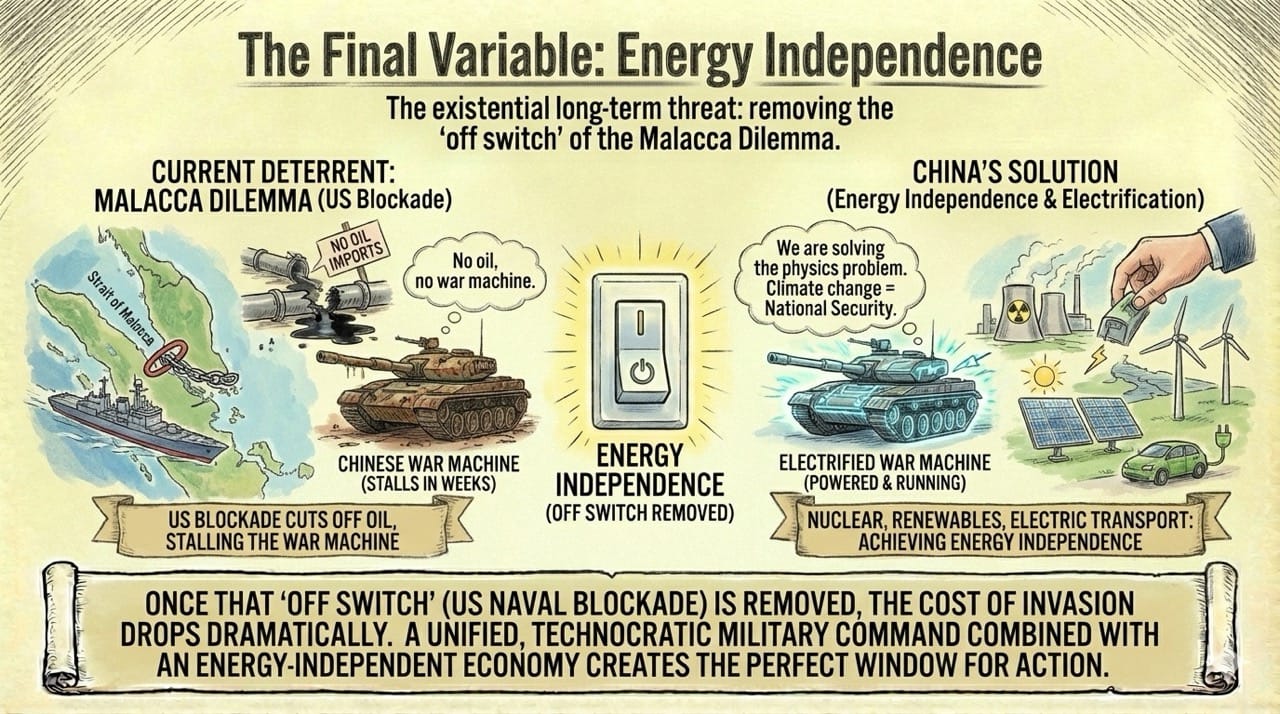
The Final Variable: Energy Independence
There is one critical piece of the puzzle that makes the long-term threat existential. Energy.
The primary US deterrent against a Taiwan invasion has always been the Malacca Dilemma. In a conflict, the US Navy can blockade the Strait of Malacca, cutting off the oil shipments that power China's economy and military. Without imported oil, the Chinese war machine stalls in weeks.
But China is solving this physics problem.
They are building nuclear power plants and renewable energy infrastructure at a rate the world has never seen. They are aggressively electrifying their transport sector. This isn't just about climate change. It is about National Security.
The moment China achieves sufficient energy independence—where they can keep the lights on and the factories running without imported oil—the US naval blockade loses its teeth.
Once that "off switch" is removed, the cost of invasion drops dramatically. A unified, technocratic military command combined with an energy-independent economy creates the perfect window for action.
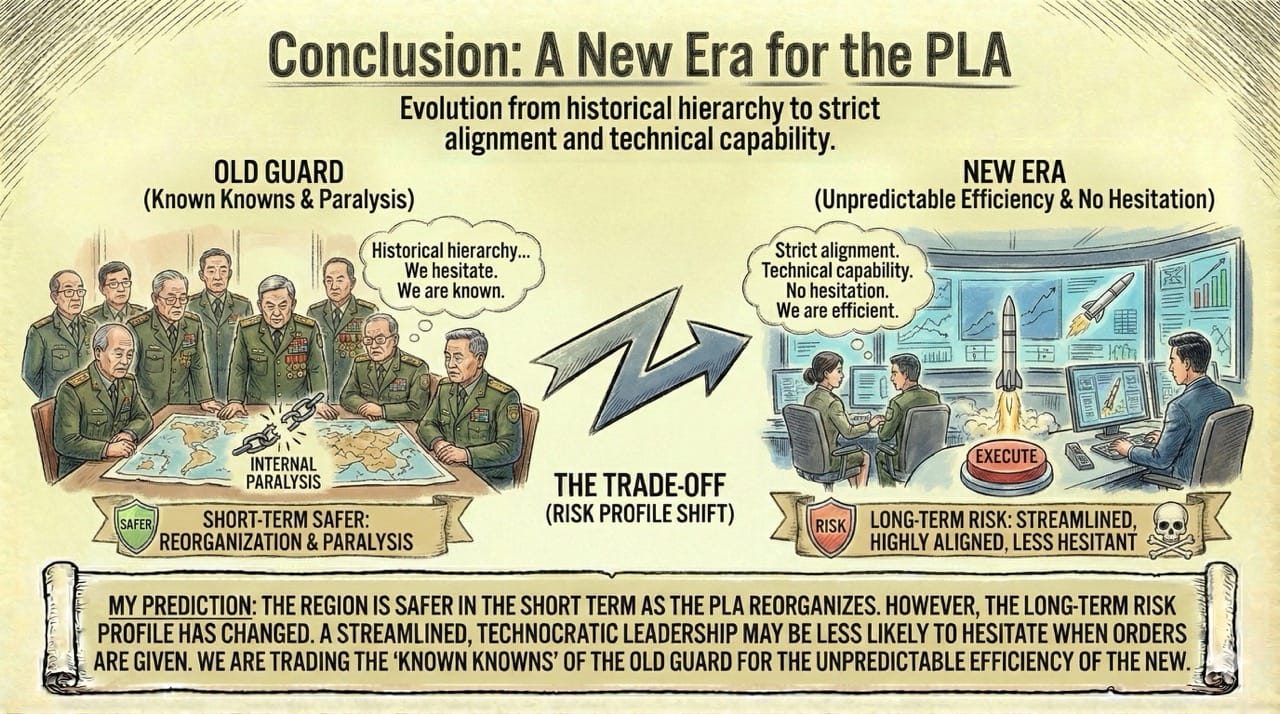
Conclusion: A New Era for the PLA
The PLA is evolving. It is moving from a structure based on historical hierarchy to one based on strict current alignment and technical capability.
My Prediction: The region is safer in the short term as the PLA reorganizes and deals with internal paralysis.
However, the long-term risk profile has changed. A streamlined, highly aligned, and technocratic military leadership structure may be less likely to hesitate when orders are given. We are trading the "known knowns" of the old guard for the unpredictable efficiency of the new.