Before We Get AGI, We Need “The Face”

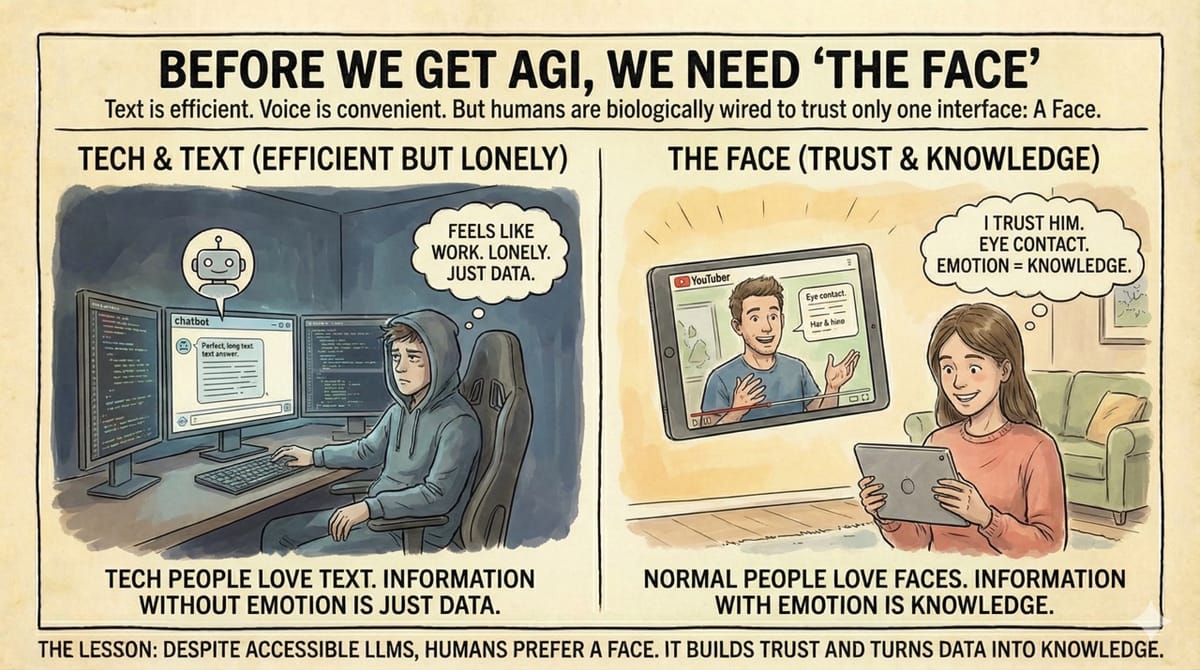
Text is efficient. Voice is convenient. But humans are biologically wired to trust only one interface: A Face.
Inspiration: Watching my friends ignore a perfect ChatGPT answer, only to watch a 15-minute YouTube video of a guy saying the exact same thing because they trusted his face.
Tech people love text. Most people love faces.
Despite how accessible LLMs are, most people resist “chatting” with a machine. It feels lonely. It feels like work.
They prefer YouTube. Why? Because a human explaining something—with eye contact, micro-expressions, and tone—builds trust. Information without emotion is just data; information with emotion is knowledge.
The “Clippy” Lesson (We Crave Humanization)
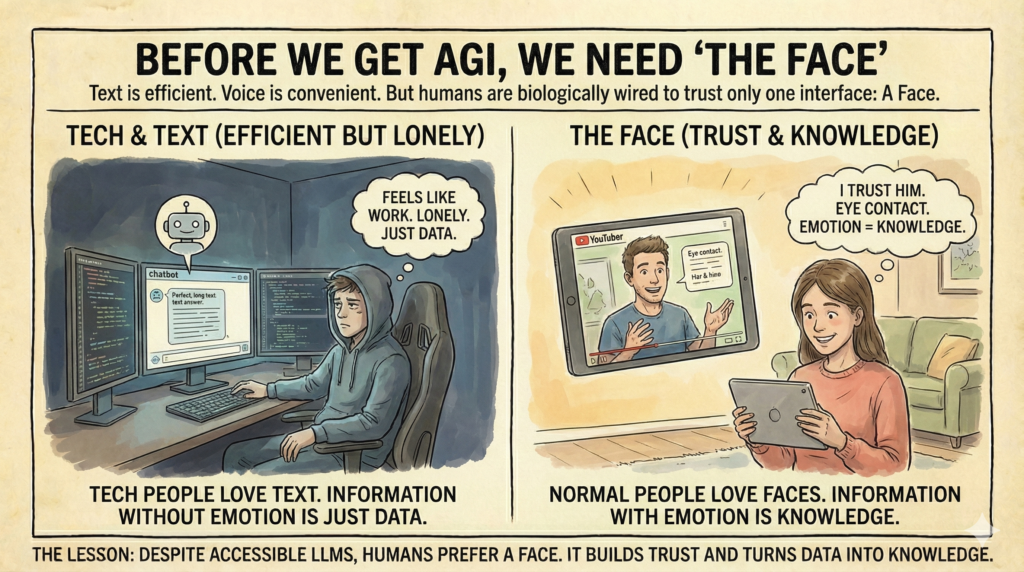
Remember Clippy? He was annoying, sure. But he was famous because he was a character. He had eyes. He looked at you.
Humans are biologically wired to project agency onto things with eyes (pareidolia). We don’t want a “tool”; we want a “helper.”
Right now, ChatGPT is a blank void. It has no soul. To reach the next billion users, AI needs to stop being a command line and start being a companion.
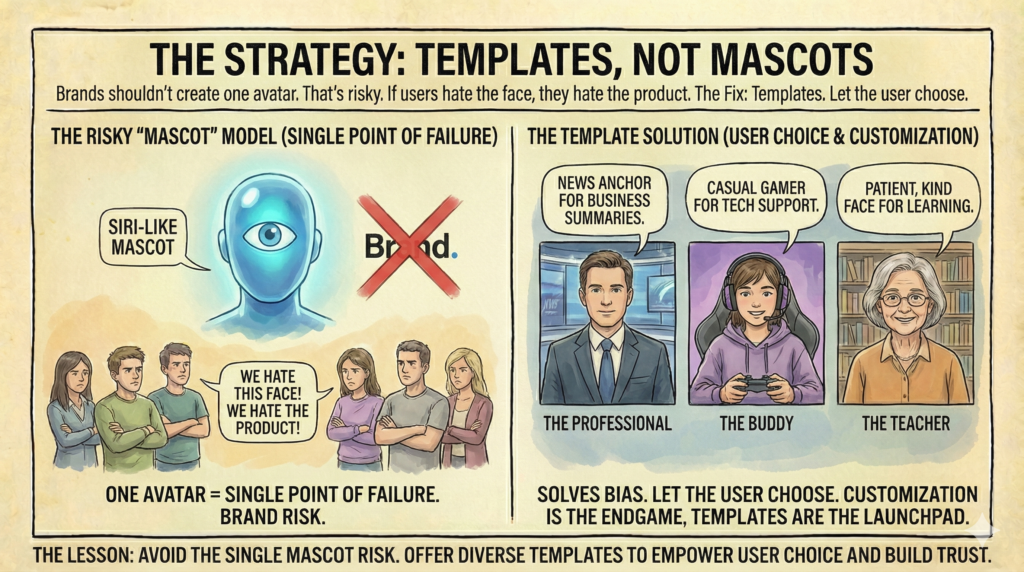
The Strategy: Templates, Not Mascots
Brands shouldn’t create one avatar (like a “Siri” face). That’s risky. If users hate the face, they hate the product.
The Fix: Templates. Just like Gemini Voices, let the user choose.
- The Professional: A news anchor for business summaries.
- The Buddy: A casual gamer for tech support.
- The Teacher: A patient, kind face for learning.
This solves the bias issue. Let the user choose an avatar that looks like them (or who they want to learn from). Customization is the endgame, but templates are the launchpad.
The Disruption: Education & YouTube
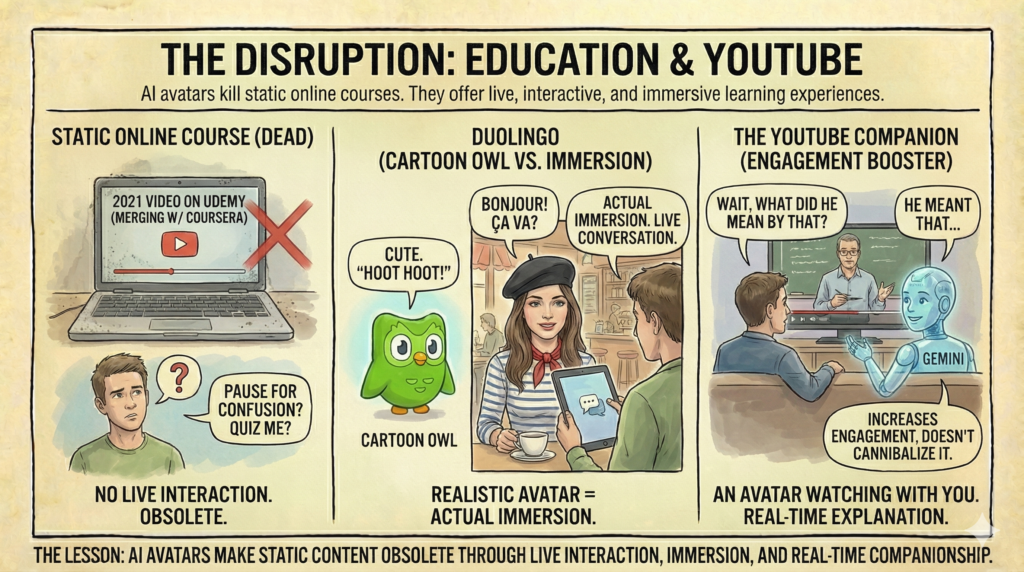
This kills the static online course.
Why watch a 2021 video on Udemy (now merging with Coursera) when a Google Avatar can teach you the material live, pause when you look confused, and quiz you?
Duolingo: A cartoon owl is cute. A realistic French avatar having a live conversation with you is actual immersion.
The YouTube Companion: Imagine the “Gemini Button” on YouTube isn’t a sidebar chat. It’s an avatar sitting “next” to you, watching the video. You turn to it and ask, “Wait, what did he mean by that?” and it explains. That increases engagement, rather than cannibalizing it.
Conclusion: The Bridge to AGI
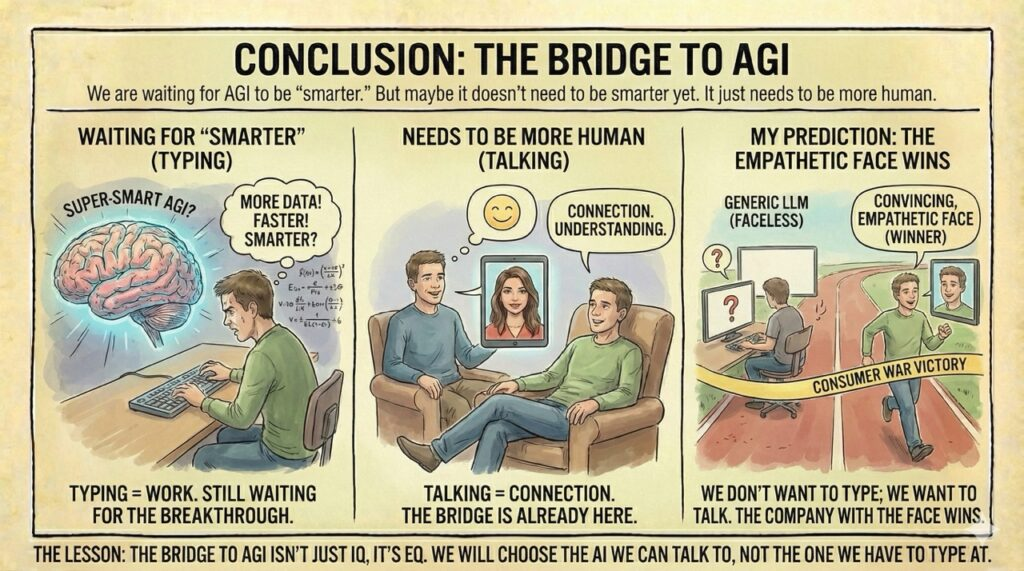
We are waiting for AGI to be “smarter.” But maybe it doesn’t need to be smarter yet. It just needs to be more human.
My Prediction: The company that puts a convincing, empathetic face on an LLM will win the consumer war. We don’t want to type; we want to talk.