Agentic Commerce: Why the "Brand Purchaser" is About to Be Automated
We talk about AI replacing writers. But the real disruption is coming for the "Purchaser." Agentic Commerce will connect the demand signal directly to the factory floor, removing the human bottleneck in the middle.

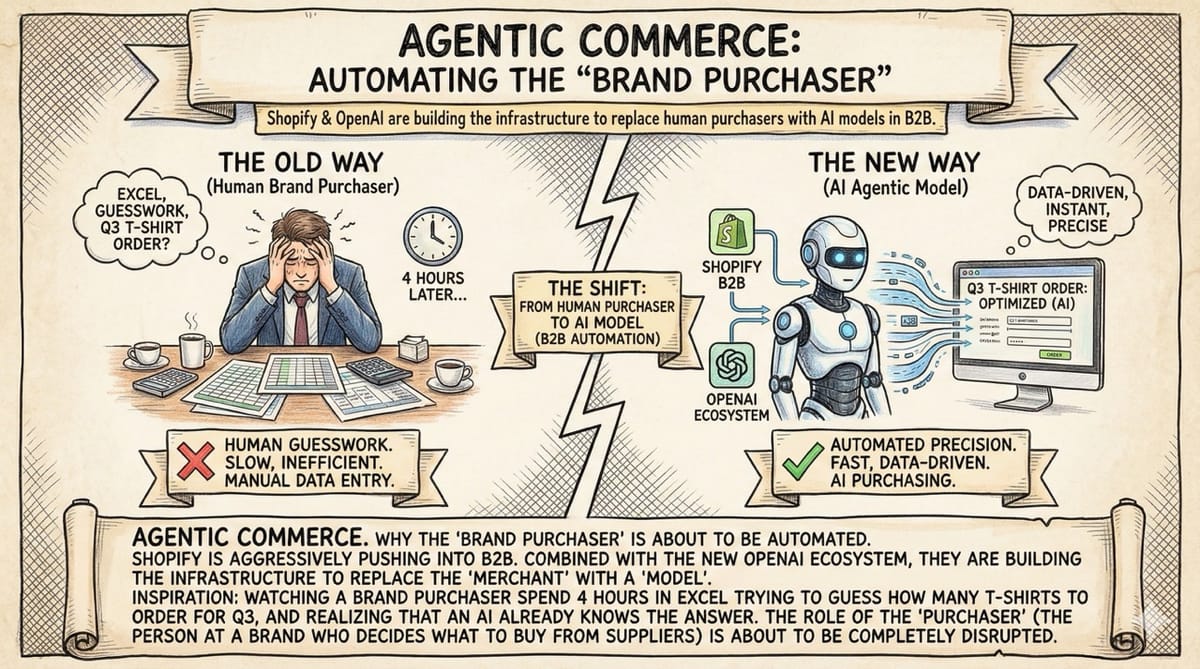
Shopify is aggressively pushing into B2B. Combined with the new OpenAI ecosystem, they are building the infrastructure to replace the "Merchant" with a "Model."
Inspiration: Watching a brand purchaser spend 4 hours in Excel trying to guess how many t-shirts to order for Q3, and realizing that an AI already knows the answer.
Everyone is talking about "Agentic Commerce" as a consumer tool. They imagine an AI booking their flights or buying their groceries.
That will happen. But the bigger, immediate disruption is in B2B.
The role of the "Purchaser" (the person at a brand who decides what to buy from suppliers) is about to be completely disrupted.
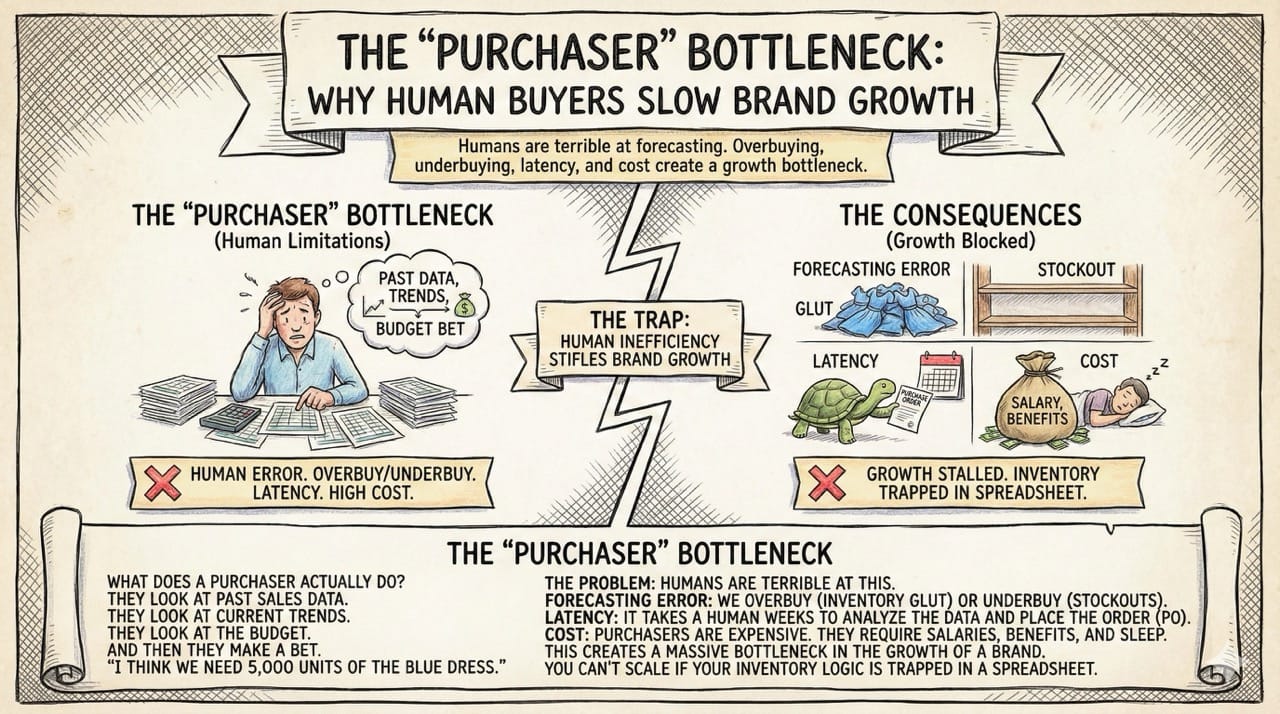
The "Purchaser" Bottleneck
What does a Purchaser actually do? They look at past sales data. They look at current trends. They look at the budget. And then they make a Bet.
- "I think we need 5,000 units of the blue dress."
The Problem: Humans are terrible at this.
- Forecasting Error: We overbuy (inventory glut) or underbuy (stockouts).
- Latency: It takes a human weeks to analyze the data and place the Purchase Order (PO).
- Cost: Purchasers are expensive. They require salaries, benefits, and sleep.
This creates a massive bottleneck in the growth of a brand. You can't scale if your inventory logic is trapped in a spreadsheet.
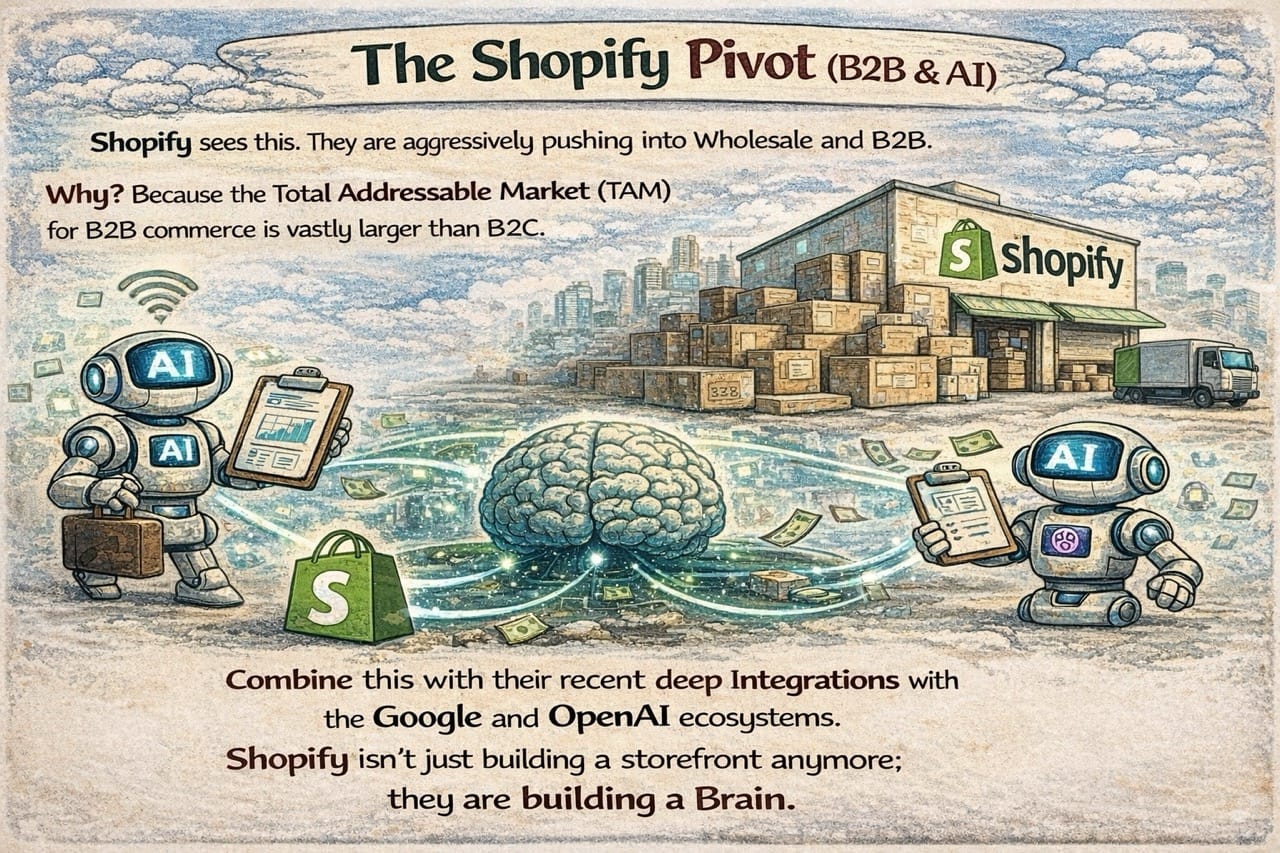
The Shopify Pivot (B2B & AI)
Shopify sees this. They are aggressively pushing into Wholesale and B2B.
Why? Because the Total Addressable Market (TAM) for B2B commerce is vastly larger than B2C.
Combine this with their recent deep integrations with the Google and OpenAI ecosystems. Shopify isn't just building a storefront anymore; they are building a Brain.
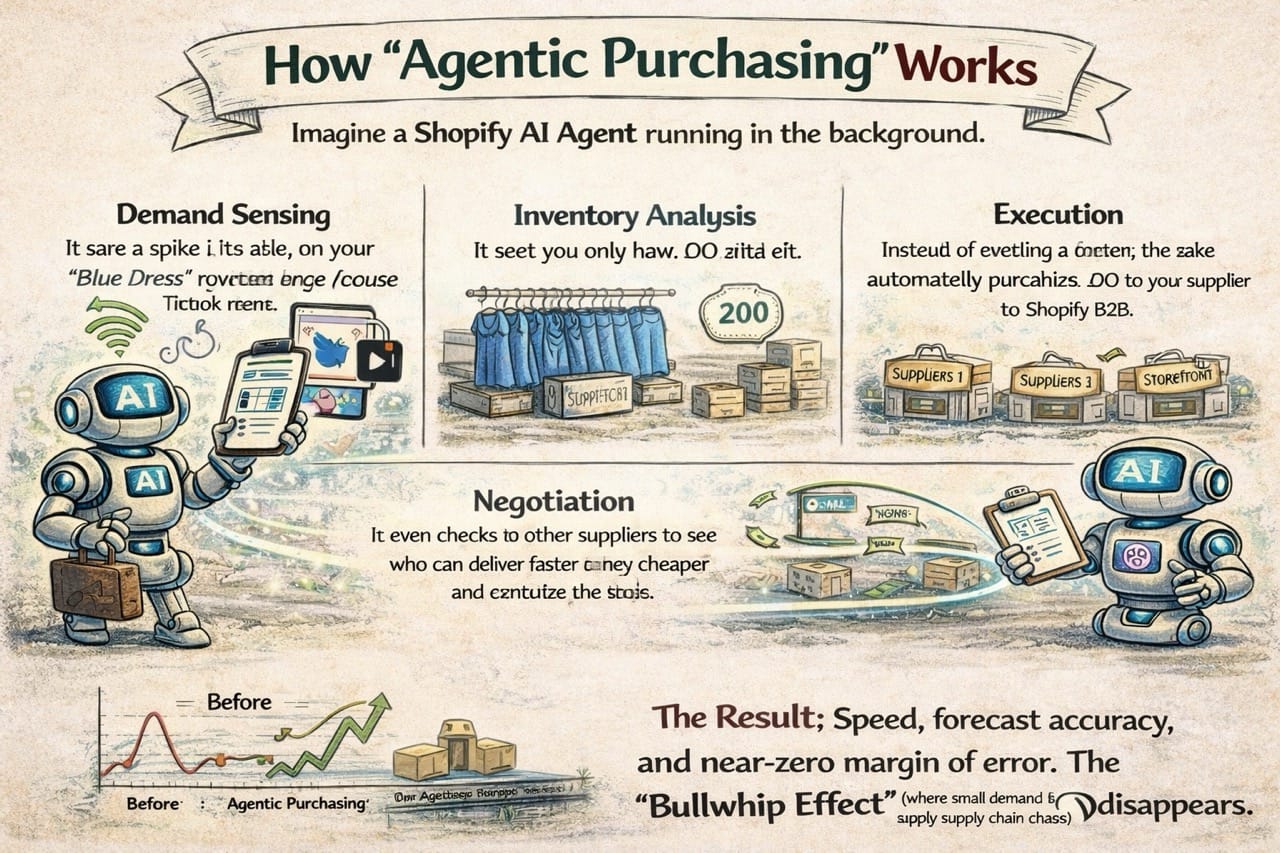
How "Agentic Purchasing" Works
Imagine a Shopify AI Agent running in the background.
- Demand Sensing: It sees a spike in traffic on your "Blue Dress" product page (Google Analytics data). It notices a TikTok trend involving blue dresses (Social Signal).
- Inventory Analysis: It sees you only have 200 units left.
- The Execution: Instead of emailing a human, the Agent automatically generates a PO to your supplier via Shopify B2B.
- Negotiation: It even checks 3 other suppliers to see who can deliver faster or cheaper, and executes the trade.
The Result: Speed, forecast accuracy, and near-zero margin of error. The "Bullwhip Effect" (where small demand shifts cause massive supply chain chaos) disappears.
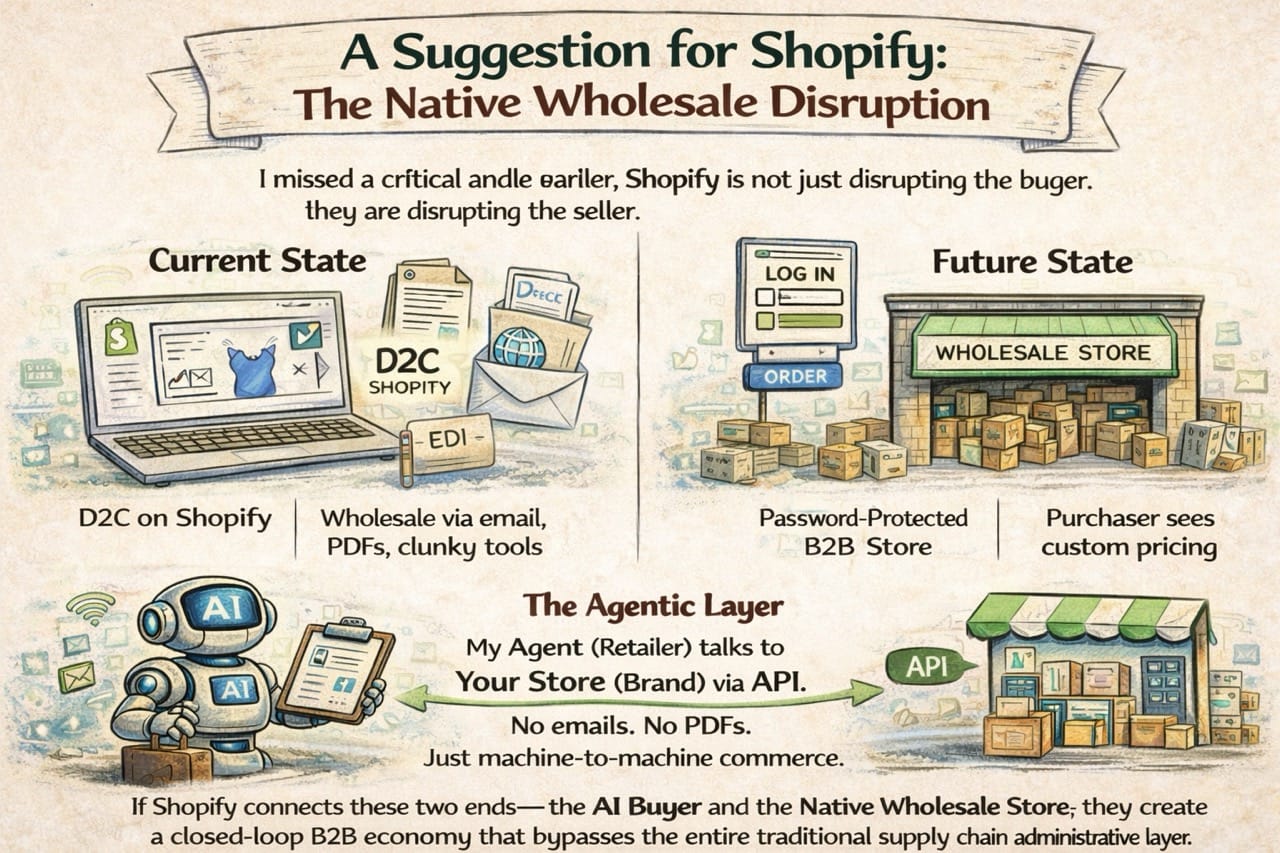
A Suggestion for Shopify: The Native Wholesale Disruption
I missed a critical angle earlier. Shopify is not just disrupting the buyer; they are disrupting the seller.
Shopify now allows any merchant to create a dedicated B2B/Wholesale Storefront natively. This is huge.
- Current State: A brand sells D2C on Shopify but handles wholesale orders via email, PDF invoices, and clunky EDI systems. It is manual and high-friction.
- Future State: Brands launch a password-protected B2B store. Retailers (the purchasers) log in and see custom pricing.
- The Agentic Layer: This allows the "Purchaser Agent" we discussed to interact directly with the "Wholesale Store."
- My Agent (Retailer) talks to Your Store (Brand) via API.
- No emails. No PDFs. Just machine-to-machine commerce.
If Shopify connects these two ends—the AI Buyer and the Native Wholesale Store—they create a closed-loop B2B economy that bypasses the entire traditional supply chain administrative layer.
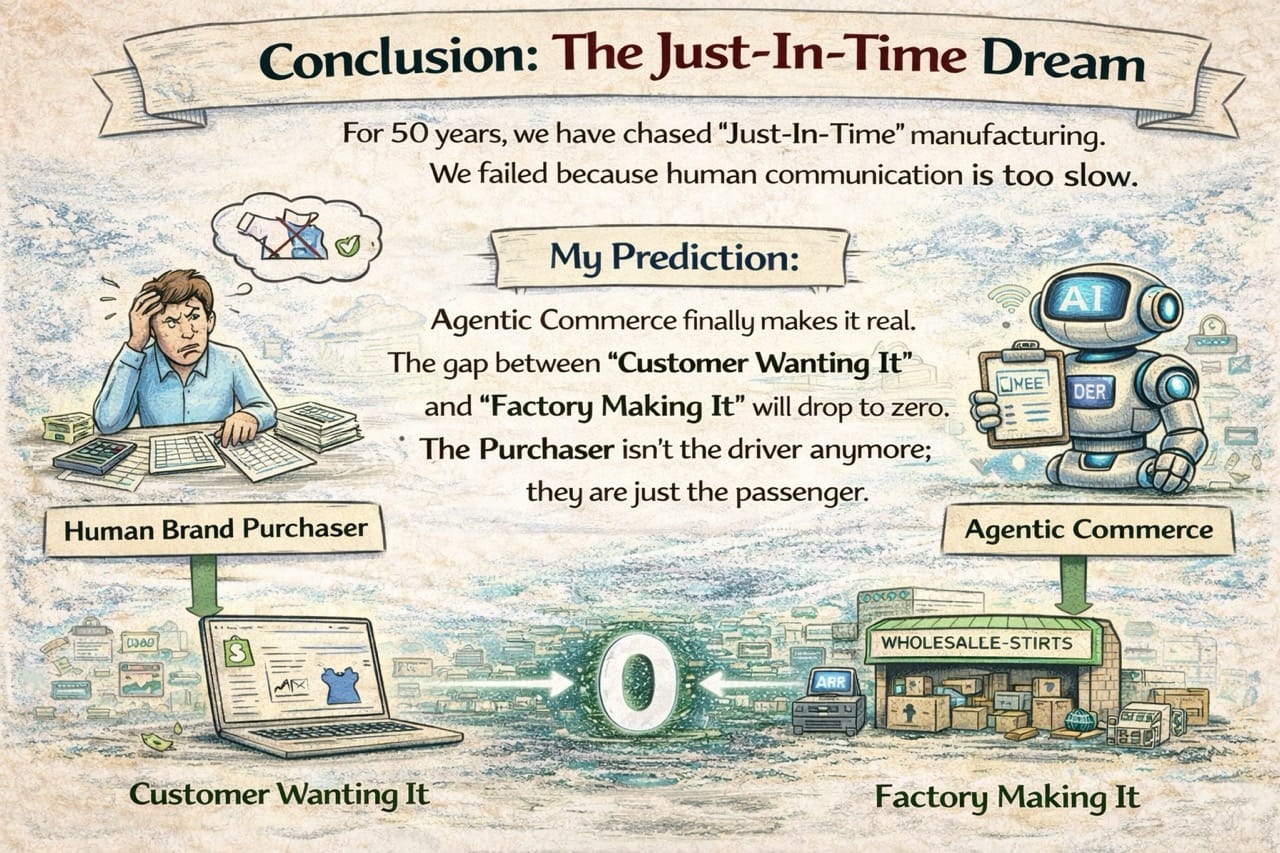
Conclusion: The Just-In-Time Dream
For 50 years, we have chased "Just-In-Time" manufacturing. We failed because human communication is too slow.
My Prediction: Agentic Commerce finally makes it real. The gap between "Customer Wanting It" and "Factory Making It" will drop to zero. The Purchaser isn't the driver anymore; they are just the passenger.