Ad Personalization Will Improve: Born In The Internet Era

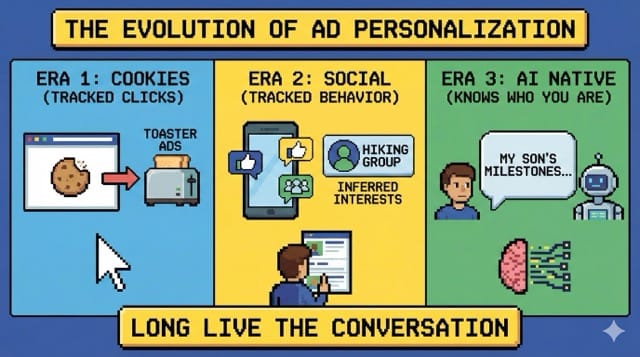
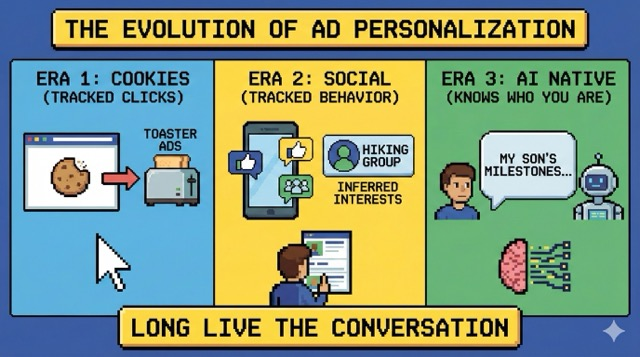
The cookie is dead. Long live the conversation. Why the next generation of ads won't just know what you clicked—they'll know who you are.
Inspiration: Realizing that AI assistant knows more about your son’s development milestones than his pediatrician does.
For the last 20 years, ad personalization has been a cat-and-mouse game.
First, we had Cookies. We tracked clicks. It was clumsy. You bought a toaster, and we showed you toaster ads for a month.
Then, we had Social. We tracked behavior. Facebook knew you liked “hiking” because you joined a hiking group. Better, but still inferred.
We are now entering Era 3 (The AI Native).
We aren’t inferring data anymore. We are being told data. The next generation isn’t just leaving a digital footprint; they are having a continuous, lifelong conversation with an intelligence layer.
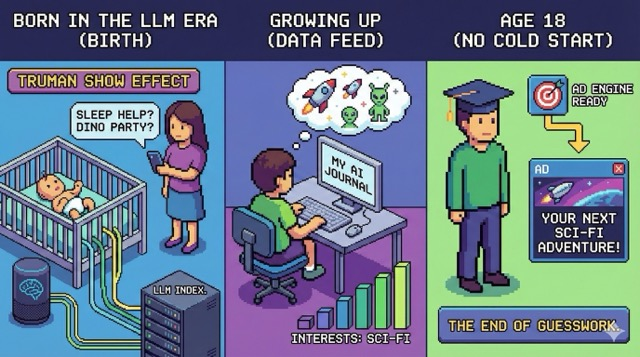
Born in the LLM Era (The “Truman Show” Effect)
Gen Alpha is the first generation to be “indexed” by AI from birth.
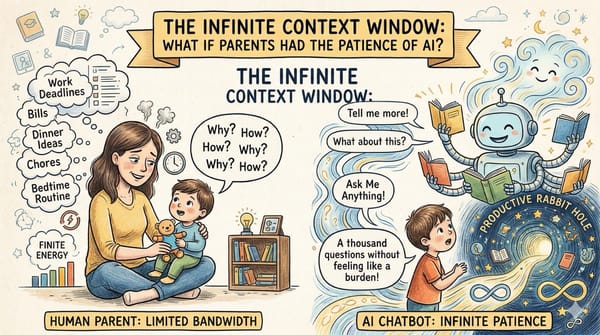
Before the kid can even speak, the parents are feeding the model. “My 2-year-old isn’t sleeping, what should I do?” “Generate a birthday invite for a dinosaur theme.”
The AI knows the child’s sleep patterns, dietary restrictions, and interests before the child even has an account.
By the time this kid is 18, the ad engine doesn’t need to guess if they like sci-fi. It knows they wrote 50 fan-fiction stories about space travel in their AI journal. The “Cold Start” problem for advertisers is solved forever.
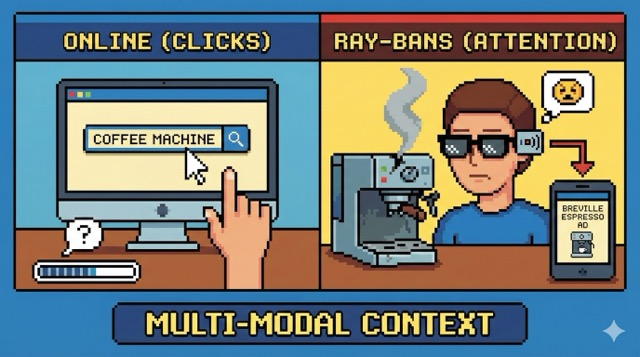
The Hardware Sensor Layer (Meta Ray-Bans)
Online, we track clicks. With Meta Ray-Bans (and future AR), we track attention.
You don’t need to search for “coffee machine.” You just look at your broken coffee machine and sigh. The glasses see it. The AI registers the frustration.
10 minutes later, you get an ad for a Breville espresso maker. It feels like magic (or telepathy). It’s actually just multi-modal context.
The NPC Trap (Video Games as Data Mines)
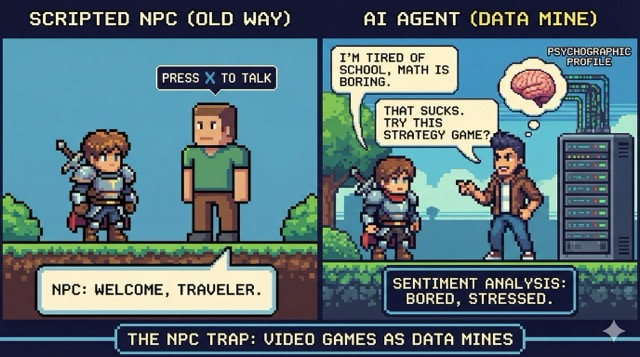
Video games are moving from scripted NPCs to AI Agents (like in Roblox or future GTA).
You don’t just press “X” to talk. You talk to them. You have full conversations.
You: “I’m tired of school, my math teacher is so boring.” NPC: “That sucks. Maybe you’d like this new strategy game instead?”
That conversation isn’t just gameplay. It’s sentiment analysis. The game knows you are bored, stressed, or ambitious based on how you treat the NPCs. That psychographic profile is gold for advertisers.
Conclusion: The End of “Marketing”
We are moving away from “Marketing” (shouting at a crowd) to “Fulfillment” (anticipating a need).
The ads will be incredibly useful. They will feel less like ads and more like helpful suggestions from a friend who knows you perfectly.
The Cost: The price of this convenience is total transparency. You can’t have a perfect assistant and perfect privacy. You have to pick one.