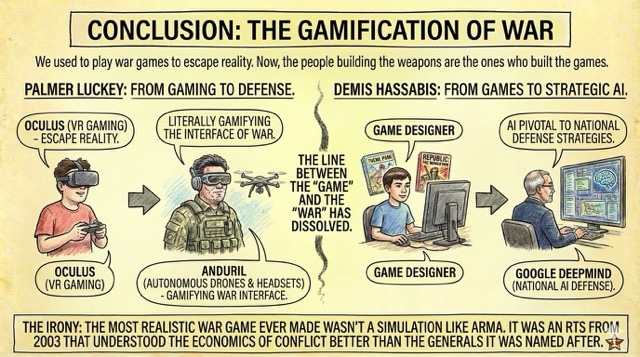
In 2003, we thought it was just a game. In 2025, it looks like a documentary.
Inspiration: Watching a news clip about drone swarms and realizing I played this exact scenario 20 years ago as the USA faction.
Command & Conquer: Generals was released in 2003.
Unlike its predecessors (Red Alert, Tiberian Sun), which were sci-fi or campy, Generals was gritty. It felt like CNN.
It was so close to reality (Global Liberation Army vs. Superpowers) that it was banned in China and heavily censored in Germany. It wasn’t predicting lasers; it was predicting insurgency.
The “USA” Faction: The Prophet of Drones
The USA faction wasn’t just about tanks. It was about unmanned superiority.
You could build a “Spy Drone” for map vision.
You could upgrade tanks with “Targeting Drones” to increase range.
You could deploy “Hunter-Killer Drones” for perimeter defense.
This is exactly how the US military evolved. We moved from “boots on the ground” to “eyes in the sky.” The game predicted that the ultimate luxury in war isn’t firepower; it’s information and safety.
Losing a drone costs money. Losing a pilot costs political capital.

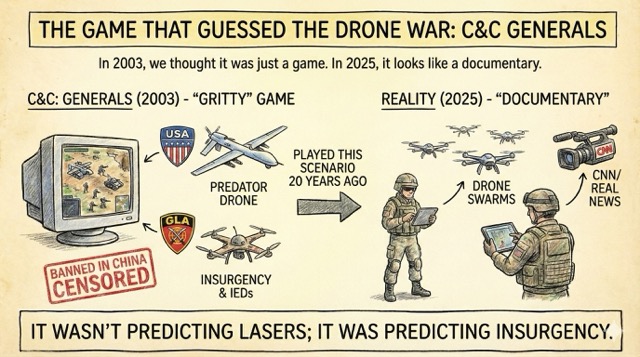
The Asymmetric Warfare (GLA vs. The World)
The game correctly predicted that the next major conflict wouldn’t be Tank vs. Tank (WW2 style). It would be High-Tech vs. No-Tech.
The GLA tactic was simple: Cheap, fast, disposable units (suicide bombers, technicals) swarming expensive, slow, high-tech units.
Look at Ukraine. A $500 consumer drone destroying a $5 million tank is the Generals “Technical vs. Overlord Tank” matchup in real life. The game understood the ROI of Asymmetry before the Pentagon did.
Other Eerie Predictions
The Hacker War: The Chinese faction generated cash via “Hackers” stealing from the internet. Today, state-sponsored cyber warfare is a primary revenue stream and weapon for nations under sanction.
The “General” System: The game introduced “Generals Points” to unlock airstrikes. In modern warfare, local commanders are increasingly given “push-button” access to precision strikes (like HIMARS), decentralizing the kill chain.

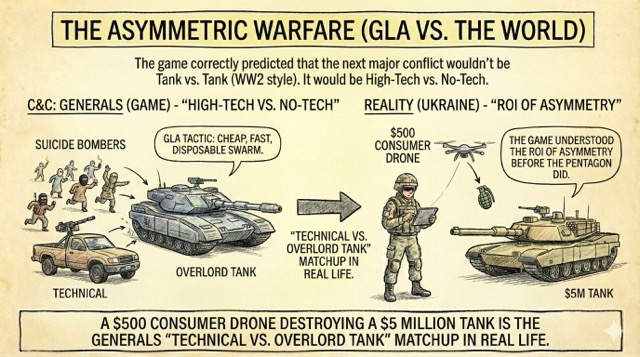
Future Warfare: What Else Did It Get Right?
The game featured the “Particle Cannon” and laser defense systems.
We are just now seeing the deployment of Iron Beam and similar directed-energy weapons to counter the drone swarms. Generals taught us that technology doesn’t just make war deadlier; it makes it faster and cheaper for the underdog.
Conclusion: The Gamification of War
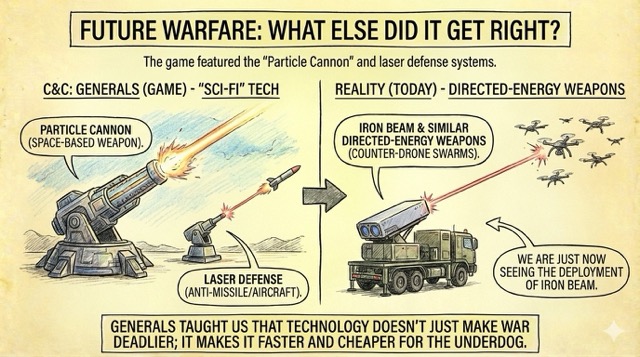
We used to play war games to escape reality. Now, the people building the weapons are the ones who built the games.
Look at Palmer Luckey. He founded Oculus (VR gaming) and now runs Anduril, building the “Eagle Eye” headset and autonomous drones. He is literally gamifying the interface of war.
Look at Demis Hassabis. The head of Google DeepMind/now-AI (pivotal to national AI defense strategies) started his career designing Theme Park and Republic: The Revolution.
The line between the “Game” and the “War” has dissolved.
The Irony: The most realistic war game ever made wasn’t a simulation like ARMA. It was an RTS from 2003 that understood the economics of conflict better than the generals it was named after.